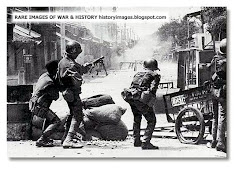
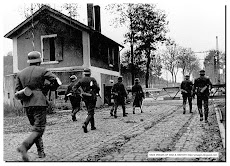
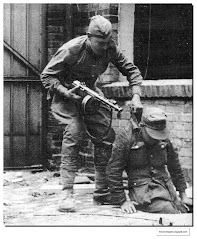
Poland saw the ugliest face of German occupation during WW2. Uglier still was how the Polish Jews were treated. Below are some images of the Nazi occupation of Poland especially life in the infamous Warsaw Ghetto.
We talk here only of the German occupation of Poland. The Russians treated it no better. But that is another story....


We talk here only of the German occupation of Poland. The Russians treated it no better. But that is another story....

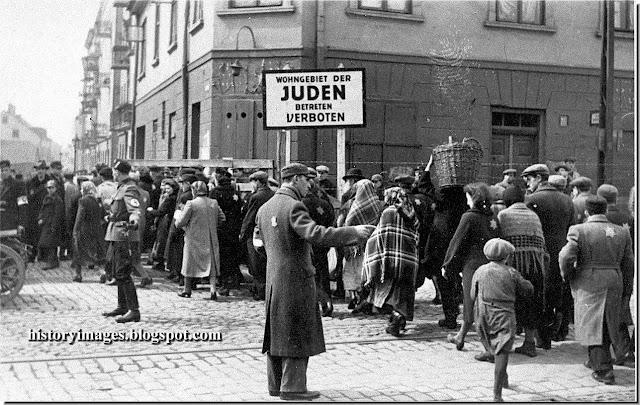
Jewish policemen and German soldiers regulate the movement of Jewish people in the ghetto Lodz
LODZ GHETTO
LODZ GHETTO
The Łódź Ghetto (German: Ghetto Litzmannstadt) was the second-largest ghetto (after the Warsaw Ghetto) established for Jews and Roma in German-occupied Poland. Situated in the town of Łódź and originally intended as a temporary gathering point for Jews, the ghetto was transformed into a major industrial centre, providing much needed supplies for Nazi Germany and especially for the German Army. Because of its remarkable productivity, the ghetto managed to survive until August 1944, when the remaining population was transported to Auschwitz and Chełmno extermination camp. It was the last ghetto in Poland to be liquidated
(From The Pianist)

------------------
A little while later the only Warsaw newspaper published in Polish by the Germans provided an official comment on this subject: not only were the Jews social parasites, they also spread infection. They were not, said the report, to be shut up in a ghetto; even the word “ghetto” was not to be used. The Germans were too cultured and magnanimous a race, said the newspaper, to confine even parasites like the Jews to ghettos, a medieval remnant unworthy of the new order in Europe. Instead, there was to be a separate Jewish quarter of the city where only Jews lived, where they would enjoy total freedom, and where they could continue to practise their racial customs and culture. Purely for hygienic reasons, this quarter was to be surrounded by a wall so that typhus and other Jewish diseases could not spread to other parts of the city. (From The Pianist)
-------------------------------------
A FILM ON POLAND UNDER GERMAN OCCUPATION

Winner of the prestigious Golden Palm award at the 2002 Cannes film festival, The Pianist is the film that Roman Polanski was born to direct. A childhood survivor of Nazi-occupied Poland, Polanski was uniquely suited to tell the story of Wladyslaw Szpilman, a Polish Jew and concert pianist (played by Adrien Brody) who witnessed the Nazi invasion of Warsaw, miraculously eluded the Nazi death camps, and survived throughout World War II by hiding among the ruins of the Warsaw ghetto. Unlike any previous dramatization of the Nazi holocaust, The Pianist steadfastly maintains its protagonist's singular point of view, allowing Polanski to create an intimate odyssey on an epic wartime scale, drawing a direct parallel between Szpilman's tenacious, primitive existence and the wholesale destruction of the city he refuses to abandon. Uncompromising in its physical and emotional authenticity, The Pianist strikes an ultimate note of hope and soulful purity. As with Schindler's List, it's one of the greatest films ever made about humanity's darkest chapter.
----------------------------------
German soldiers on the background of a bridge near the Polish town of Sanok. In 1942.
SANOK TOWN IN POLAND
SANOK TOWN IN POLAND
During the Second Polish Republic (1919–1939), Sanok was a known centre of Ukrainian nationalism in Galicia, but also of cultural heritage of the Lemkos and other Rusyns. In 1943 the foundation of the Waffen-SS Division Galizien took place in heavily Ukrainian-populated Sanok, with many locals volunteering in the ethnic Ukrainian Waffen-SS. Because of fear of Ukrainian separatism by both Soviet and Polish authorities, the Ukrainian and Lemko population of Sanok and its region was mostly deported to the former eastern territories of Germany attached to Poland after World War II (the so-called Recovered Territories) during Operation Vistula (1946–1947). Some the Lemkos expelled returned to Sanok after 1989.

Governor-General of occupied Poland, Hans Frank in Poland at the town of Sanok
HITLER'S PLANS FOR POLAND
HITLER'S PLANS FOR POLAND
From the beginning, the invasion of Poland by Nazi Germany was intended as fulfillment of the plan described by Adolf Hitler in his book Mein Kampf as the Lebensraum. The occupation goal was to turn former Poland into ethnically German "living space", as well as to exploit the material resources of the country and to maximise the use of Polish manpower as a reservoir of slave labour. The Polish nation was to be effectively reduced to the status of Serfdom, its political, religious and intellectual leadership destroyed. One aspect of German policy in conquered Poland aimed to prevent its ethnically diverse population from uniting against Germany. In a top-secret memorandum, "The Treatment of Racial Aliens in the East", dated May 25, 1940, Heinrich Himmler, head of the SS, wrote: "We need to divide Poland's many different ethnic groups up into as many parts and splinter groups as possible".
--------
HANS FRANK WAS VIRULENTLY ANTI-JEW
HANS FRANK WAS VIRULENTLY ANTI-JEW
Frank was a virulent anti-semite, and in December 1941 he records in his diary his infamous speech;
As far as the Jews are concerned I want to tell you quite frankly that they must be done away with in one way or another I know that many of the measures carried out against the Jews in the Reich at present are being criticised. Before I continue, I want to beg you to agree with me on the following formula: We will in principle have pity on the German people only and nobody else in the whole world. The others too had no pity on us. As an old National Socialist I must say this: Jews used as slave labour in Poland This war would be only a partial success if the whole of Jewry survive it, while we had shed our best blood in order to save Europe. My attitude towards the Jews will therefore be based only on the expectation that they must disappear. They must be done away with. Gentlemen, I must ask you to rid yourselves of all feeling of pity. We must annihilate the Jews wherever we find them and wherever it is possible, in order to maintain the structure of the Reich as a whole.
Source
As far as the Jews are concerned I want to tell you quite frankly that they must be done away with in one way or another I know that many of the measures carried out against the Jews in the Reich at present are being criticised. Before I continue, I want to beg you to agree with me on the following formula: We will in principle have pity on the German people only and nobody else in the whole world. The others too had no pity on us. As an old National Socialist I must say this: Jews used as slave labour in Poland This war would be only a partial success if the whole of Jewry survive it, while we had shed our best blood in order to save Europe. My attitude towards the Jews will therefore be based only on the expectation that they must disappear. They must be done away with. Gentlemen, I must ask you to rid yourselves of all feeling of pity. We must annihilate the Jews wherever we find them and wherever it is possible, in order to maintain the structure of the Reich as a whole.
Source
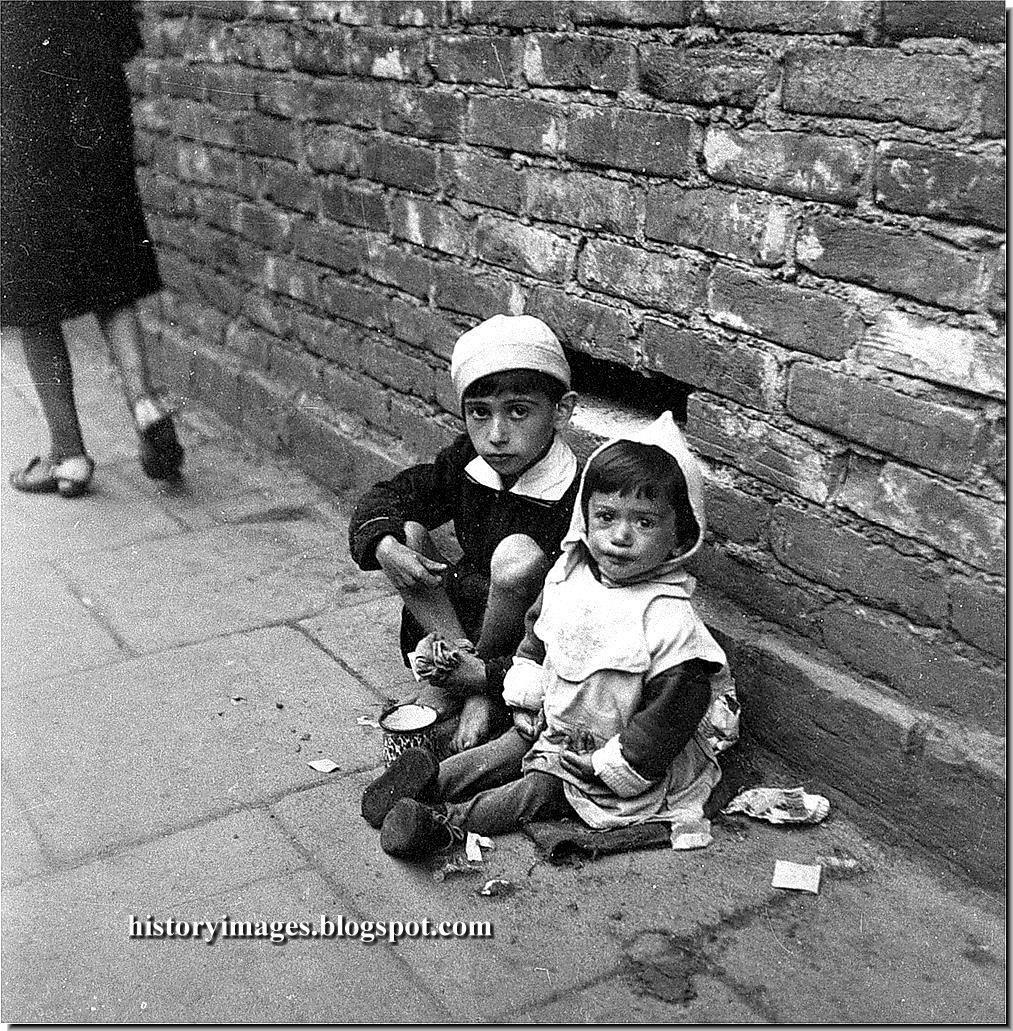
Jewish children beg for food at the Warsaw Ghetto
The Warsaw Ghetto was the largest of all Jewish Ghettos in Nazi-occupied Europe during World War II. It was established in the Polish capital between October and November 15, 1940, in the territory of General Government of the German-occupied Poland, with over 400,000 Jews from the vicinity crammed into an area of 1.3 square miles From there, about 254,000 Ghetto residents were sent to Treblinka extermination camp during the two months of summer 1942. The sheer death-toll among the Jewish inhabitants of the Ghetto during the Großaktion Warschau would have been difficult to compare even with the liquidation of the Ghetto in spring of next year during and after the Warsaw Ghetto Uprising which meant annihilation of an additional 50,000 people followed by the actual razing of the ghetto

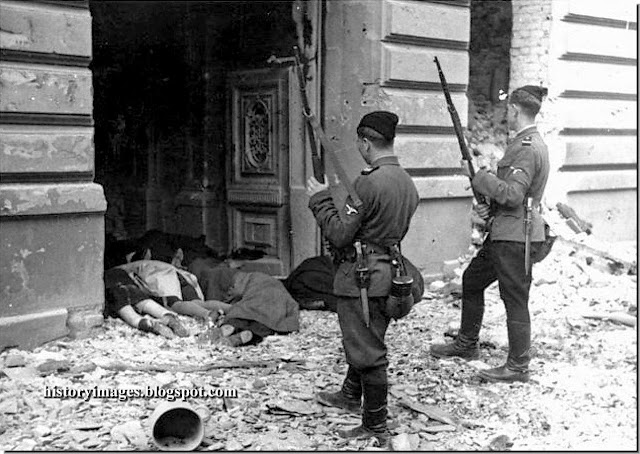
Two members of the Ukrainian SS, known as "Askaris", look at the bodies of women and children killed during the uprising in the Warsaw ghetto. In 1943.
ASKARIS
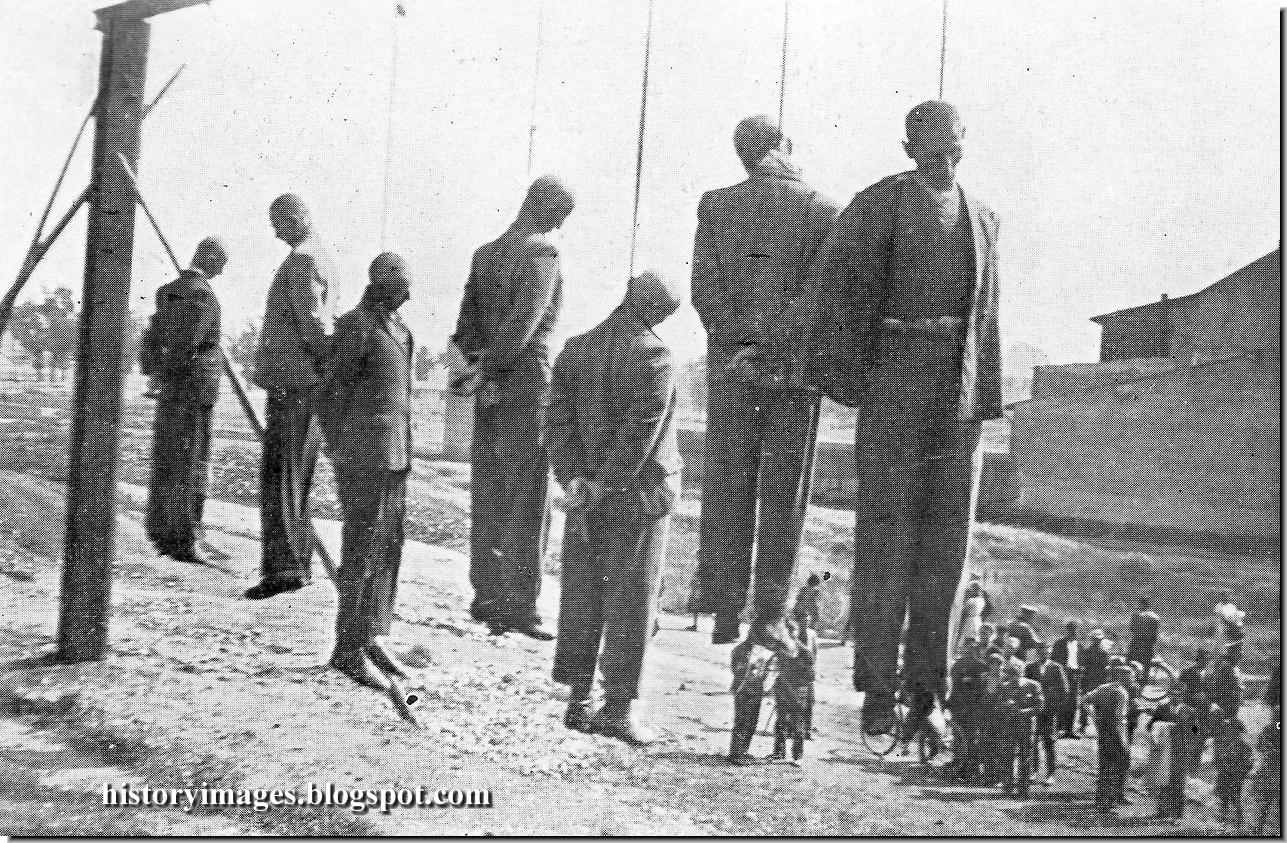
 German soldiers executing Polish civilians. December 18, 1939. Polish city of Bochnia. 56 people were executed.
 The collaborators. Polish policemen under German rule
 The Warsaw Ghetto after the Uprising. 1943
THE WARSAW GHETTO UPRISING
(From Ushmm)

 Jewish youth loiter on the Nowolipie Street in the Warsaw Ghetto. 1943
 Mockery of the Jews in the Lodz ghetto - they were forced to stand with a poster that said "We want war." The inscription on the cart says "The Jews are our misfortune"
 A German officer instructs children from the Lublin ghetto. December 1940. "Do not forget to wash every day."
 The Poles view a German poster. On the orders of Propaganda Minister Joseph Goebbels Warsaw was plastered with posters depicting wounded Polish soldier pointing to the ruins of the city, and saying: "The English, this is your job". In November 1939 alone, two women were executed for the destruction of the poster
 Public executions in Krakow. June 26, 1942
 Jewish children from the ghetto in the Polish city Shidlovets (Szydlowiec). December 20, 1940. During World War II. The Germans founded two ghettos here, with about 16.000 Jews gathered in them in total. In September 1942 about 10.000 Jews were taken to the extermination camp in Treblinka. In November 1942 the rest of them were taken there.
 A German executioner squad (Einsatzgruppen) questions Jews who survived the Warsaw Ghetto Uprising during April-May 1943. Second from right is Josef Blosche, the infamous killer during the Ghetto Uprising
WHO WAS JOSEF BLOSCHE?
 The famous photo with Josef Blosche in the right

 Summer 1941. A vegetable stall in the Warsaw Ghetto
 Firewood being sold in the Ghetto
 Shoes for sale in the Ghetto
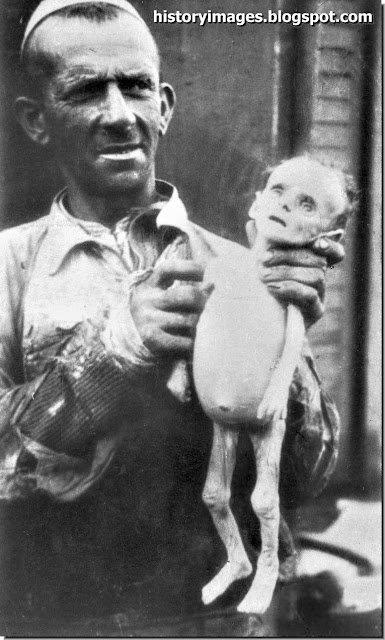 This Jewish baby died of hunger

 Welcome! Time for tea.
 A corpse lies unattended on the sidewalk in the Ghetto. Life had no value.
 These women try to sell something and earn some bread
 This man is sick and emaciated
 A Jewish family with a samovar
 1943. Jewish Rabbi in the Warsaw ghetto
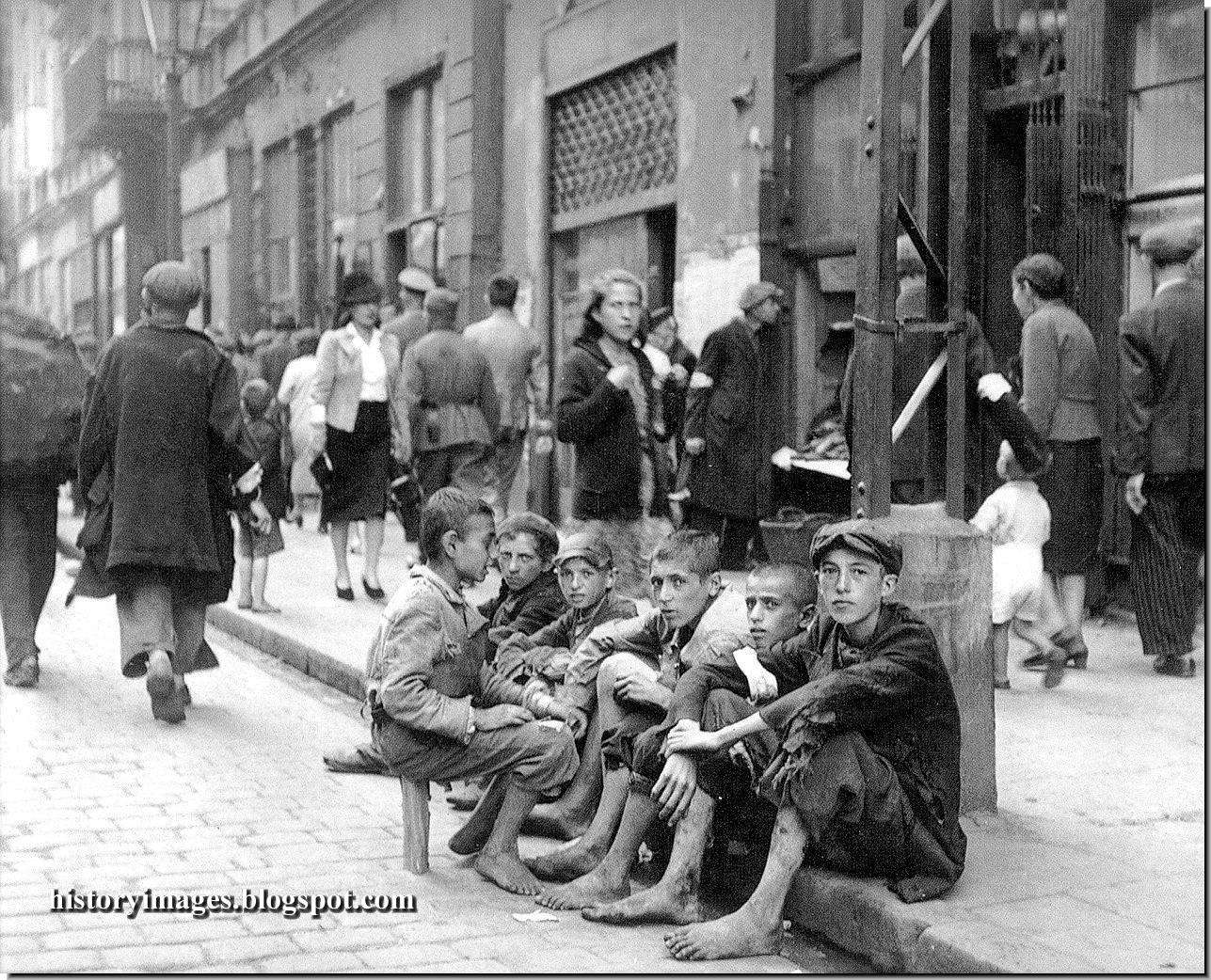
 Jewish children beg for food on the street of the Warsaw Ghetto
 This kind man (He is Jewish too. Note the armband. All Jews were supposed to wear them) gives some food to the starving children
THE JEWISH POLICE
 An elderly Jewish man in the Ghetto
---------------------------
"THE PIANIST" THE BOOK
 The Pianist: The Extraordinary True Story of One Man's Survival in Warsaw, 1939-1945
by
Wladyslaw Szpilman
RELATED: Warsaw Ghetto Uprising, 1943
--------------------
FILM ON THE WARSAW GHETTO UPRISING
"THE UPRISING" (2001)

ASKARIS
During WWII, the Germans used the nickname "askari" for the East European deserters or prisoners who switched sides and collaborated with the Nazis. Members of the Latvian Arajs Kommando and Lithuanian auxiliary militia Saugumas were also nicknamed "askaris" during 1943-45. This term was also applied to the Ukrainian volunteer units like the Nachtigall Battalion, Schuma battalions, and the 14th Waffen Grenadier Division of the SS, which was used in many operations during WWII. Most of them were either Red Army deserters or anti-communist peasants recruited from Ukrainian rural areas under German occupation.
Russian volunteer soldiers under German command, such as the RONA units employed during the Warsaw Uprising of 1944, were also informally referred to as "askaris".

In contrast to the Nazi policy of genocide targeting all of Poland's 3.3 million Jewish men, women, and children for elimination, Nazi plans for the Polish Catholic majority focused on the elimination or suppression of political, religious, and intellectual leaders. This policy had two aims: first, to prevent Polish elites from organizing resistance or from ever regrouping into a governing class; second, to exploit the less educated majority of peasants and workers as unskilled laborers in agriculture and industry
From 1939-1941, the Germans deported en masse about 1,600,000 Poles, including 400,000 Jews. About 700,000 Poles were sent to Germany for forced labor, many to die there. And the most infamous German death camps had been located in Poland. Overall, during German occupation of pre-war Polish territory, 1939–1945, the Germans murdered 5,470,000-5,670,000 Poles, including nearly 3,000,000 Jews. Altogether, 2,500,000 Poles were subjected to expulsions, while 7.3% of the Polish population served as slave labor.


THE WARSAW GHETTO UPRISING
(From Ushmm)
Between July 22 and September 12, 1942, the German authorities deported or murdered around 300,000 Jews in the Warsaw ghetto. SS and police units deported 265,000 Jews to the Treblinka killing center and 11,580 to forced-labor camps. The Germans and their auxiliaries murdered more than 10,000 Jews in the Warsaw ghetto during the deportation operations. The German authorities granted only 35,000 Jews permission to remain in the ghetto, while more than 20,000 Jews remained in the ghetto in hiding. For the at least 55,000-60,000 Jews remaining in the Warsaw ghetto, deportation seemed inevitable.
In response to the deportations, on July 28, 1942, several Jewish underground organizations created an armed self-defense unit known as the Jewish Combat Organization(Zydowska Organizacja Bojowa; ZOB). Rough estimates put the size of the ZOB at its formation at around 200 members. The Revisionist Party (right-wing Zionists known as the Betar) formed another resistance organization, the Jewish Military Union (Zydowski Zwiazek Wojskowy; ZZW). Although initially there was tension between the ZOB and the ZZW, both groups decided to work together to oppose German attempts to destroy the ghetto. At the time of the uprising, the ZOB had about 500 fighters in its ranks and the ZZW had about 250. While efforts to establish contact with the Polish military underground movement (Armia Krajowa, or Home Army) did not succeed during the summer of 1942, the ZOB established contact with the Home Army in October, and obtained a small number of weapons, mostly pistols and explosives, from Home Army contacts.
In accordance with Reichsführer-SS (SS chief) Heinrich Himmler's October 1942 order to liquidate the Warsaw ghetto and deport its able-bodied residents to forced labor camps in Lublin District of the Generalgouvernement, German SS and police units tried to resume mass deportations of Jews from Warsaw on January 18, 1943. A group of Jewish fighters, armed with pistols, infiltrated a column of Jews being forced to the Umschlagplatz (transfer point) and, at a prearranged signal, broke ranks and fought their German escorts.
Most of these Jewish fighters died in the battle, but the attack sufficiently disoriented the Germans to allow the Jews arranged in columns at the Umschlagplatz a chance to disperse. After seizing 5,000-6,500 ghetto residents to be deported, the Germans suspended further deportations on January 21. Encouraged by the apparent success of the resistance, which they believed may have halted deportations, members of the ghetto population began to construct subterranean bunkers and shelters in preparation for an uprising should the Germans attempt a final deportation of all remaining Jews in the reduced ghetto.
The German forces intended to begin the operation to liquidate the Warsaw ghetto on April 19, 1943, the eve of Passover. When SS and police units entered the ghetto that morning, the streets were deserted. Nearly all of the residents of the ghetto had gone into hiding places or bunkers. The renewal of deportations was the signal for an armed uprising within the ghetto.
ZOB commander Mordecai Anielewicz commanded the Jewish fighters in the Warsaw ghetto uprising. Armed with pistols, grenades (many of them homemade), and a few automatic weapons and rifles, the ZOB fighters stunned the Germans and their auxiliaries on the first day of fighting, forcing the German forces to retreat outside the ghetto wall. German commander SS General Jürgen Stroop reported losing 12 men, killed and wounded, during the first assault on the ghetto. On the third day of the uprising, Stroop's SS and police forces began razing the ghetto to the ground, building by building, to force the remaining Jews out of hiding. Jewish resistance fighters made sporadic raids from their bunkers, but the Germans systematically reduced the ghetto to rubble. The German forces killed Anielewicz and those with him in an attack on the ZOB command bunker on 18 Mila Street, which they captured on May 8.
Though German forces broke the organized military resistance within days of the beginning of the uprising, individuals and small groups hid or fought the Germans for almost a month.
To symbolize the German victory, Stroop ordered the destruction of the Great Synagogue on Tlomacki Street on May 16, 1943. The ghetto itself was in ruins. Stroop reported that he had captured 56,065 Jews and destroyed 631 bunkers. He estimated that his units killed up to 7,000 Jews during the uprising. The German authorities deported approximately another 7,000 Warsaw Jews to the Treblinka killing center, where almost all were killed in the gas chambers upon arrival. The Germans deported almost all of the remaining Jews, approximately 42,000, to the Lublin/Majdanek concentration camp, and to the Poniatowa, Trawniki, Budzyn, and Krasnik forced-labor camps. With the exception of a few thousand forced laborers at Budzyn and Krasnik, German SS and police units later murdered almost all of the Warsaw Jews deported to Lublin/Majdanek, Poniatowa, and Trawniki in November 1943 in “Operation Harvest Festival” (Unternehmen Erntefest).
The Germans had planned to liquidate the Warsaw ghetto in three days, but the ghetto fighters held out for more than a month. Even after the end of the uprising on May 16, 1943, individual Jews hiding out in the ruins of the ghetto continued to attack the patrols of the Germans and their auxiliaries. The Warsaw ghetto uprising was the largest, symbolically most important Jewish uprising, and the first urban uprising, in German-occupied Europe.

Remains of the Warsaw Ghetto in 1945
 The destruction of the Warsaw ghetto. Poland, in 1943.
WARSAW GHETTO UPRISING
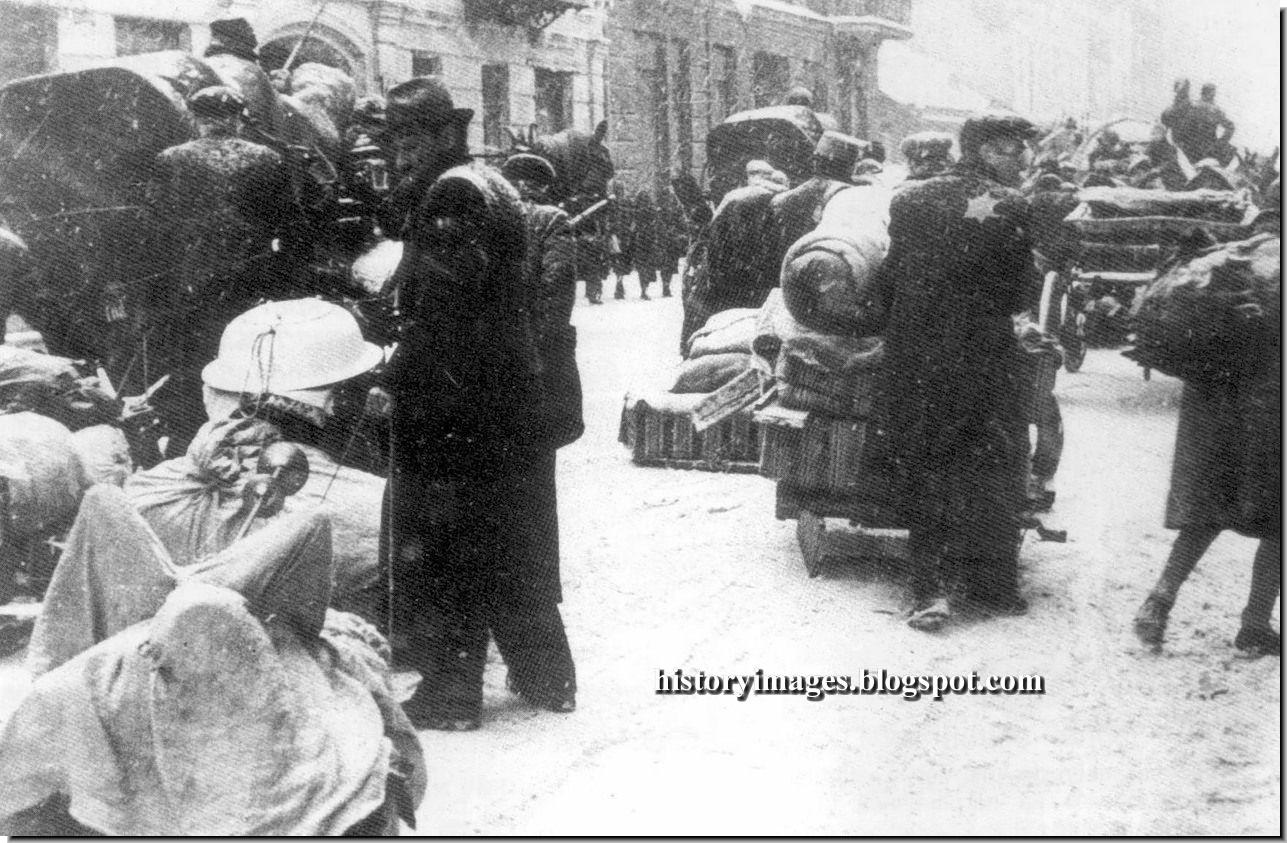
 The forced resettlement of Jews in urban ghetto at Lodz. March 1940.
 A middle-aged Jew being arrested in Warsaw. Poland had a large Jewish population. After the invasion the Germans quickly started isolating it.
(From The Pianist)

WARSAW GHETTO UPRISING
On January 18, 1943, after almost four months without any deportations, the Germans suddenly entered the Warsaw ghetto intent upon a further deportation. Within hours, some 600 Jews were shot and 5,000 others rounded up. The Germans expected no resistance, but preparations to resist had been going on since the previous autumn.The first instances of Jewish armed resistance began that day. The Jewish fighters had some success: the expulsion stopped after four days and the ŻOB and ŻZW resistance organizations took control of the Ghetto, building shelters and fighting posts and operating against Jewish collaborators.
The final battle started on the eve of Passover of April 19, 1943, when a Nazi force consisting of several thousand troops entered the ghetto. After initial setbacks, the Germans under the field command of Jürgen Stroop systematically burned and blew up the ghetto buildings, block by block, rounding up or murdering anybody they could capture. Significant resistance ended on April 23, and the Nazi operation officially ended in mid-May, symbolically culminating with the demolition of the Great Synagogue of Warsaw on May 16. According to the official report, at least 56,065 people were killed on the spot or deported to German Nazi concentration and death camps, most of them to Treblinka.

(From The Pianist)
By the time we had made our way to the train the first trucks were
already full. People were standing in them pressed close to each other.
SS men were still pushing with their rifle butts, although there were loud cries from inside and complaints about the lack of air. And indeed the smell of chlorine
made breathing difficult, even some distance from the trucks. What went
on in there if the floors had to be so heavily chlorinated? We had gone
about halfway down the train when I suddenly heard someone shout,
‘Here! Here, Szpilman!’ A hand grabbed me by the collar, and I was flung
back and out of the police cordon.
Who dared do such a thing? I didn’t want to be parted from my family. I wanted to stay with them!
My view was now of the closed ranks of the policemen’s backs. I threw
myself against them, but they did not give way. Peering past the
policemen’s heads I could see Mother and Regina, helped by Halina and
Henryk, clambering into the trucks, while Father was looking around for
me.
“Papa!” I shouted.
He saw me and took a couple of steps my way, but then hesitated and
stopped. He was pale, and his legs trembled nervously. He tried to
smile, helplessly, painfully, raised his hand and waved goodbye, as if I
were setting out into life and he was already greeting me from beyond
the grave. Then he turned and went towards the trucks.
“Papa! Henryk! Halina!”
I shouted like someone possessed, terrified to think that now, at the
last vital moment, I might not get to them and we would be parted for
ever.
One of the policemen turned and looked angrily at me.
“What the hell do you think you’re doing? Go on, save yourself!”
Save myself? From what? In a flash I realized what awaited the people in
the cattle trucks. My hair stood on end. I glanced behind me. I saw the
open compound, the railway lines and platforms, and beyond them the
streets. Driven by compulsive animal fear, I ran for the streets,
slipped in among a column of Council workers just leaving the place, and
got through the gate that way.
During the next year and a half, thousands of Polish Jews as well as some Romani people from smaller cities and the countryside were brought into the Ghetto, while diseases (especially typhus), and starvation kept the inhabitants at about the same number. Average food rations in 1941 for Jews in Warsaw were limited to 186 calories, compared to 1,669 calories for gentile Poles and 2,614 calories for Germans
WARSAW GHETTO VIDEO


Unemployment was a major problem in the ghetto. Illegal workshops were created to manufacture goods to be sold illegally on the outside and raw goods were smuggled in, often by children. Hundreds of four to five year old Jewish children went across en masse to the "Aryan side," sometimes several times a day, smuggling food into the ghettos, returning with goods that often weighed more than they did. Smuggling was often the only source of subsistence for Ghetto inhabitants, who would otherwise have died of starvation.
THE VIDEOS ARE IN POLISH BUT THE VISUALS ARE GRIPPING. THEY SAY IT ALL...


One day when I was walking along beside the wall I saw a childish smuggling operation that seemed to have reached a successful conclusion. The Jewish child still on the far side of the wall only needed to follow his goods back through the opening. His skinny little figure was already partly in view when he suddenly began screaming, and at the same time I heard the hoarse bellowing of a German on the other side of the wall. I ran to the child to help him squeeze through as quickly as possible, but in defiance of our efforts his hips stuck in the drain. I pulled at his little arms with all my might, while his screams became increasingly desperate, and I could hear the heavy blows struck by the policeman on the other side of the wall. When I finally managed to pull the child through, he died. His spine had been shattered.
(From The Pianist)
(From The Pianist)

WHO WAS JOSEF BLOSCHE?
Josef Blösche (February 12, 1912 – July 29, 1969) was a member of the National Socialist German Workers Party (Nazi Party) in Germany, and served in the SS and SD during World War II as a Rottenführer (Section Leader). Blösche became known to the world as a symbol of the Nazi cruelty inflicted on people within the Warsaw ghetto because of a famous photograph (See the image below) taken during the Warsaw Ghetto Uprising which portrays a surrendering little boy in the foreground, and Blösche as the SS soldier who is facing the boy with an MP18 sub-machine gun in hand.


Dozens of beggars lay in wait for this brief moment of encounter with a prosperous citizen, mobbing him by pulling at his clothes, barring his way, begging, weeping, shouting, threatening. But it was foolish for anyone to feel sympathy and give a beggar something, for then the shouting would rise to a howl. That signal would bring more and more wretched figures streaming up from all sides, and the good Samaritan would find himself besieged, hemmed in by ragged apparitions spraying him with tubercular saliva, by children covered with oozing sores who were pushed into his path, by gesticulating stumps of arms, blinded eyes, toothless, stinking open mouths, all begging for mercy at this, the last moment of their lives, as if their end could be delayed only by instant support.
(From The Pianist)

(From The Pianist)

A woman and a Jewish policeman speak to a German soldier in the Warsaw Ghetto

THE JEWISH POLICE
You could have said, perhaps, that they caught the Gestapo spirit. As soon as they put on their uniforms and police caps and picked up their rubber truncheons, their natures changed. Now their ultimate ambition was to be in close touch with the Gestapo, to be useful to Gestapo officers, parade down the street with them, show off their knowledge of the German language and vie with their masters in the harshness of their dealings with the Jewish population.

---------------------------
"THE PIANIST" THE BOOK

by
Wladyslaw Szpilman
"Stunning . . . Filled with unforgettable incidents, images, and people."— The Wall Street Journal
"Remarkable . . . a document of lasting historical and human value."—The Los Angeles Times
"Historically indispensible."—Washington Post Book World
"The Pianist is a great book."—The Boston Globe
"Even by the standards set be Holocaust memoirs, this book is a stunner."—Seattle Weekly
"A stunning tribute to what one human being can endure, The Pianist is even more—a testimony to the redemptive power of fellow feeling."—The Plain Dealer
"Distinguished by [Szpilman's] dazzling clarity . . . Remarkably lucid."—Publishers Weekly (starred review)
"A striking Holocaust memoir that conveys with exceptional immediacy and cool reportage the author's desperate fight for survival."—Kirkus Reviews
"The Pianist is a book so fresh and vivid, so heartbreaking, and so simply and beautifully written, that it manages to tell us the story of horrendous events as if for the first time . . . an altogether unforgettable book. "—The Daily Telegraph
"Wladyslaw Szpilman's memoir of life in Nazi-occupied Warsaw and the Jewish ghetto has a singular vividness. All is conveyed with an understated intimacy and dailiness that render them painfully close."—The Observer
"It is all told with a simple clarity that lodges the story in one's stomach through a mixture of disgust, terror, despair, rage, and guilt that grips the reader almost gently. "—The Spectator
"Illuminates vividly the horror that overcame the Polish people. Szpilman's account has an immediacy, vivid and anguished."—The Sunday Telegraph
"Remarkable . . . a document of lasting historical and human value."—The Los Angeles Times
"Historically indispensible."—Washington Post Book World
"The Pianist is a great book."—The Boston Globe
"Even by the standards set be Holocaust memoirs, this book is a stunner."—Seattle Weekly
"A stunning tribute to what one human being can endure, The Pianist is even more—a testimony to the redemptive power of fellow feeling."—The Plain Dealer
"Distinguished by [Szpilman's] dazzling clarity . . . Remarkably lucid."—Publishers Weekly (starred review)
"A striking Holocaust memoir that conveys with exceptional immediacy and cool reportage the author's desperate fight for survival."—Kirkus Reviews
"The Pianist is a book so fresh and vivid, so heartbreaking, and so simply and beautifully written, that it manages to tell us the story of horrendous events as if for the first time . . . an altogether unforgettable book. "—The Daily Telegraph
"Wladyslaw Szpilman's memoir of life in Nazi-occupied Warsaw and the Jewish ghetto has a singular vividness. All is conveyed with an understated intimacy and dailiness that render them painfully close."—The Observer
"It is all told with a simple clarity that lodges the story in one's stomach through a mixture of disgust, terror, despair, rage, and guilt that grips the reader almost gently. "—The Spectator
"Illuminates vividly the horror that overcame the Polish people. Szpilman's account has an immediacy, vivid and anguished."—The Sunday Telegraph
EXCERPTS FROM THE BOOK
(from Grandpappy.info)
Wladyslaw Szpilman was born in 1911. He was 28 years old when Germany invaded Poland in 1939 at the beginning of World War II. He was a musician and a Jew and in the year 1939 he and his family (father, mother, brother, and two sisters) were all living together in a third-floor apartment flat in Warsaw, Poland.
By 31 August 1939 everyone in Warsaw had been sure for some time that
war with the Germans was inevitable. Only incorrigible optimists had
still cherished the delusion that Poland's determined stance would deter
Hitler at the last moment. (22)
I was living with my parents, my sisters and my brother in Sliska Street, working for Polish Radio as a pianist. I was late home that last day of August, and as I felt tired I went straight to bed. Our flat was on the third floor ... The noise of explosions woke me. It was light already. I looked at the time: six o'clock. (22-23)
There was no panic. The mood swung between curiosity - what would happen next? - and surprise: was this the way it all began? (24)
The streets looked almost normal. There was a great deal of traffic in the main thoroughfares of the city - trams, cars and pedestrians; the shops were open, and since the mayor had appealed to the population not to hoard food, assuring us that there was no need to do so, there were not even any queues outside them. (26-27)
The declaration of war by France and Great Britain became a reality on 3 September. (27)
The streets, so clean only yesterday, were now full of rubbish and dirt. (31)
This was the one point on which the heroic city mayor Starzynski had been wrong: he should not have advised the people against laying in stocks of food. The city now had to feed not only itself but all the soldiers trapped inside it. (36)
During this penultimate stage of the siege the population's hysterical fear of sabotage reached its height. Anyone could be accused of spying and shot at any moment, before they had time to explain himself. (37)
I played in front of the microphone for the last time on 23 September. I have no idea how I reached the broadcasting center that day. I ran from the entrance of one building to the entrance of another. ... On that final day at the radio station, I was giving a Chopin recital. It was the last live music broadcast from Warsaw. ... That same day, at three-fifteen in the afternoon, Warsaw Radio went off the air. (37-39)
Warsaw surrendered on Wednesday, 27 September. (40)
At this early stage anger with the government and the army command, both of which had fled, leaving the country to its fate, was in general stronger than hatred for the Germans. (44)
The first German decrees carrying the death penalty for failure to comply were posted up. The most important concerned trading in bread: anyone caught buying or selling bread at higher than pre-war prices would be shot. ... Soon decrees applying exclusively to Jews were being published. (44-45)
In the second half of November, without giving any reasons, the Germans began barricading the side streets north of Marszalkowska Street with barbed wire, and at the end of the month there was an announcement that no one could believe at first. Not in our most secret thoughts would we every have suspected that such a thing could happen: Jews had from the first to the fifth of December to provide themselves with white armbands on which a blue Star of David must be sewn. So we were to be publicly branded as outcasts. Several centuries of humanitarian progress were to be cancelled out, and we were back in the Middle Ages. (54)
Months of bad winter weather set in, unheralded, and the cold seemed to unite with the Germans to kill people. ... I remember a whole series of days when we had to stay in bed because the temperature in the flat was too cold to endure. (54)
Instead, there was to be a separate Jewish quarter of the city where only Jews lived, where they would enjoy total freedom, and where they could continue to practice their racial customs and culture. Purely for hygienic reasons, this quarter was to be surrounded by a wall so that typhus and other Jewish diseases could not spread to other parts of the city. ... The gates of the ghetto were closed on 15 November. (58-59)
The reality of the ghetto was all the worse just because it had the appearance of freedom. You could walk out into the street and maintain the illusion of being in a perfectly normal city. (63)
Merely getting from the tram stop to the nearest shop was not easy. Dozens of beggars lay in wait for this brief moment of encounter with a prosperous citizen, mobbing him by pulling at his clothes, barring his way, begging, weeping, shouting, threatening. But it was foolish for anyone to feel sympathy and give a beggar something, for then the shouting would rise to a howl. That signal would bring more and more wretched figures streaming up from all sides, and the good Samaritan would find himself besieged, hemmed in by ragged apparitions spraying him with tubercular saliva, by children covered with oozing sores who were pushed into his path, by gesticulating stumps of arms, blinded eyes, toothless, stinking open mouths, all begging for mercy at this, the last moment of their lives, as if their end could be delayed only by instant support. (68)
Karmelicka Street was a particularly dangerous place: prison cars drove down it several times a day. They were taking prisoners, invisible behind gray steel sides and small opaque glass windows, from the Pawiak gaol to the Gestapo centre in Szuch Alley, and on the return journey they brought back what remained of them after their interrogation: bloody scraps of humanity with broken bones and beaten kidneys, their fingernails torn out. ... The Gestapo men would lean out and beat the crowd indiscriminately with truncheons. This would not have been especially dangerous had they been ordinary rubber truncheons, but those used by the Gestapo men were studded with nails and razor blades. (69)
A few steps ahead of me a poor woman was carrying a can wrapped in newspaper, and between me and the woman a ragged old man was dragging himself along. ... Suddenly the old man lunged forward, seized the can and tried to tear it away from the woman. ... Instead of ending up in his hands the can fell on the pavement, and thick, steaming soup poured out into the dirty street. ... The woman was speechless with horror. The grabber stared at the can, then at the woman, and let out a groan that sounded like a whimper. Then, suddenly, he threw himself down full length in the slush, lapping the soup straight from the pavement, cupping his hands round it on both sides so that none of it would escape him, and ignoring the woman's reaction as she kicked at his head, howling, and tore at her hair in despair. (74)
This was the winter of 1941 to 1942, a very hard winter in the ghetto. The poor were already severely debilitated by hunger and had no protection from the cold, since they could not possibly afford fuel. They were also infested with vermin. The ghetto swarmed with vermin, and nothing could be done about it. The clothing of people you passed in the street was infested by lice, and so were the interiors of trams and shops. Lice crawled over the pavements, up stairways, and dropped from the ceilings of the public offices that had to be visited on so many different kinds of business. Lice found their way into the folds of your newspaper, into your small change; there were even lice on the crust of the loaf you had just bought. And each of these verminous creatures could carry typhus. An epidemic broke out in the ghetto. The mortality figures for death from typhus were five thousand people every month. In the ghetto, there was no way of burying those who died of typhus fast enough to keep up with the mortality rate. (16-18)
These ghosts of children now emerged from the basements, alleys and doorways where they slept, spurred on by hope that they might yet arouse pity in human hearts at this last hour of the day. They stood by lamp-posts, by the walls of buildings and in the road, heads raised, monotonously whimpering that they were hungry. "We are so very, very hungry. We haven't eaten anything for ages. Give us a little bit of bread, or if you don't have any bread then a potato or an onion, just to keep us alive till morning." But hardly anyone had that onion, and if he did he could not find it in his heart to give it away, for the war had turned his heart to stone. (21)
In the early spring of 1942 human-hunting in the ghetto, previously a systematically conducted pursuit, suddenly stopped. (75)
That evening it was announced that curfew would be postponed until midnight, so that the families of those "sent for labour" would have time to bring them blankets, a change of underwear and food for the journey. This "magnanimity" on the part of the Germans was truly touching, and the Jewish police made much of it in an effort to win our confidence. Not until much later did I learn that the thousand men rounded up in the ghetto had been taken straight to the camp at Treblinka, so that the Germans could test the efficiency of the newly built gas chambers and crematorium furnaces. (78)
Meanwhile the SS had already taken a couple dozen men from the building out into the street. They switched on the headlights of their car, forced the prisoners to stand in the beam, started the engines and made the men run ahead of them in the white cone of light. We heard convulsive screaming from the windows of the building, and a volley of machine-gun fire from the car. The men running ahead of it fell one by one, lifted into the air by the bullets, turning somersaults and describing a circle, as if the passage from life to death consisted of an extremely difficult and complicated leap. ... The SS men all got into the car and drove away over the dead bodies. The vehicle swayed slightly as it passed over them, as if it were bumping over shallow potholes. (80-81)
The Germans hit upon yet another bright idea to ease their task. Decrees appeared on the walls stating that all families who voluntarily came to the Umschlagplatz to "emigrate" would get a loaf of bread and a kilo of jam per person, and such volunteer families would not be separated. There was a massive response to this offer. People were anxious to take it up both because they were hungry and in the hope of going the unknown, difficult way to their fate together. (94)
Another guest at the Sienna Street cafe was one of the finest people I have ever met, Janusz Korczak. ... Years ago, at the start of his career, he had devoted every minute of his free time and every zloty he had available to the cause of the children, and he was devoted to them until his death. He founded orphanages, organized all kinds of collections for poor children and gave talks on the radio, winning himself wide popularity (and not just among children) as the "Old Doctor." When the ghetto gates closed he came inside them, although he could have saved himself, and he continued his mission within the walls as adoptive father to a dozen Jewish orphans, the poorest and most abandoned children in the world. (15)
The evacuation of the Jewish orphanage run by Janusz Korczak had been ordered for that morning. The children were to have been taken away alone. He had a chance to save himself, and it was only with difficulty that he persuaded the Germans to take him too. ... He told them to wear their best clothes, and so they came out into the yard, two by two, nicely dressed and in a happy mood. The column was led by an SS man who loved children, as Germans do, even those he was about to see on their way into the next world. He took a special liking to a boy of twelve, a violinist who had his instrument under his arm. The SS man told him to go to the head of the procession of children and play - and so they set off. When I met them in Gesia Street the smiling children were singing in chorus, the little violinist was playing for them and Korczak was carrying two of the smallest infants, who were beaming too, and telling them some amusing story. I am sure that even in the gas chamber, as the Cyclon B gas was stifling childish throats and striking terror instead of hope into the orphans' hearts, the Old Doctor must have whispered with one last effort, "It's all right, children, it will be all right," so that at least he could spare his little charges the fear of passing from life to death. (96-97)
I was living with my parents, my sisters and my brother in Sliska Street, working for Polish Radio as a pianist. I was late home that last day of August, and as I felt tired I went straight to bed. Our flat was on the third floor ... The noise of explosions woke me. It was light already. I looked at the time: six o'clock. (22-23)
There was no panic. The mood swung between curiosity - what would happen next? - and surprise: was this the way it all began? (24)
The streets looked almost normal. There was a great deal of traffic in the main thoroughfares of the city - trams, cars and pedestrians; the shops were open, and since the mayor had appealed to the population not to hoard food, assuring us that there was no need to do so, there were not even any queues outside them. (26-27)
The declaration of war by France and Great Britain became a reality on 3 September. (27)
The streets, so clean only yesterday, were now full of rubbish and dirt. (31)
This was the one point on which the heroic city mayor Starzynski had been wrong: he should not have advised the people against laying in stocks of food. The city now had to feed not only itself but all the soldiers trapped inside it. (36)
During this penultimate stage of the siege the population's hysterical fear of sabotage reached its height. Anyone could be accused of spying and shot at any moment, before they had time to explain himself. (37)
I played in front of the microphone for the last time on 23 September. I have no idea how I reached the broadcasting center that day. I ran from the entrance of one building to the entrance of another. ... On that final day at the radio station, I was giving a Chopin recital. It was the last live music broadcast from Warsaw. ... That same day, at three-fifteen in the afternoon, Warsaw Radio went off the air. (37-39)
Warsaw surrendered on Wednesday, 27 September. (40)
At this early stage anger with the government and the army command, both of which had fled, leaving the country to its fate, was in general stronger than hatred for the Germans. (44)
The first German decrees carrying the death penalty for failure to comply were posted up. The most important concerned trading in bread: anyone caught buying or selling bread at higher than pre-war prices would be shot. ... Soon decrees applying exclusively to Jews were being published. (44-45)
In the second half of November, without giving any reasons, the Germans began barricading the side streets north of Marszalkowska Street with barbed wire, and at the end of the month there was an announcement that no one could believe at first. Not in our most secret thoughts would we every have suspected that such a thing could happen: Jews had from the first to the fifth of December to provide themselves with white armbands on which a blue Star of David must be sewn. So we were to be publicly branded as outcasts. Several centuries of humanitarian progress were to be cancelled out, and we were back in the Middle Ages. (54)
Months of bad winter weather set in, unheralded, and the cold seemed to unite with the Germans to kill people. ... I remember a whole series of days when we had to stay in bed because the temperature in the flat was too cold to endure. (54)
Instead, there was to be a separate Jewish quarter of the city where only Jews lived, where they would enjoy total freedom, and where they could continue to practice their racial customs and culture. Purely for hygienic reasons, this quarter was to be surrounded by a wall so that typhus and other Jewish diseases could not spread to other parts of the city. ... The gates of the ghetto were closed on 15 November. (58-59)
The reality of the ghetto was all the worse just because it had the appearance of freedom. You could walk out into the street and maintain the illusion of being in a perfectly normal city. (63)
Merely getting from the tram stop to the nearest shop was not easy. Dozens of beggars lay in wait for this brief moment of encounter with a prosperous citizen, mobbing him by pulling at his clothes, barring his way, begging, weeping, shouting, threatening. But it was foolish for anyone to feel sympathy and give a beggar something, for then the shouting would rise to a howl. That signal would bring more and more wretched figures streaming up from all sides, and the good Samaritan would find himself besieged, hemmed in by ragged apparitions spraying him with tubercular saliva, by children covered with oozing sores who were pushed into his path, by gesticulating stumps of arms, blinded eyes, toothless, stinking open mouths, all begging for mercy at this, the last moment of their lives, as if their end could be delayed only by instant support. (68)
Karmelicka Street was a particularly dangerous place: prison cars drove down it several times a day. They were taking prisoners, invisible behind gray steel sides and small opaque glass windows, from the Pawiak gaol to the Gestapo centre in Szuch Alley, and on the return journey they brought back what remained of them after their interrogation: bloody scraps of humanity with broken bones and beaten kidneys, their fingernails torn out. ... The Gestapo men would lean out and beat the crowd indiscriminately with truncheons. This would not have been especially dangerous had they been ordinary rubber truncheons, but those used by the Gestapo men were studded with nails and razor blades. (69)
A few steps ahead of me a poor woman was carrying a can wrapped in newspaper, and between me and the woman a ragged old man was dragging himself along. ... Suddenly the old man lunged forward, seized the can and tried to tear it away from the woman. ... Instead of ending up in his hands the can fell on the pavement, and thick, steaming soup poured out into the dirty street. ... The woman was speechless with horror. The grabber stared at the can, then at the woman, and let out a groan that sounded like a whimper. Then, suddenly, he threw himself down full length in the slush, lapping the soup straight from the pavement, cupping his hands round it on both sides so that none of it would escape him, and ignoring the woman's reaction as she kicked at his head, howling, and tore at her hair in despair. (74)
This was the winter of 1941 to 1942, a very hard winter in the ghetto. The poor were already severely debilitated by hunger and had no protection from the cold, since they could not possibly afford fuel. They were also infested with vermin. The ghetto swarmed with vermin, and nothing could be done about it. The clothing of people you passed in the street was infested by lice, and so were the interiors of trams and shops. Lice crawled over the pavements, up stairways, and dropped from the ceilings of the public offices that had to be visited on so many different kinds of business. Lice found their way into the folds of your newspaper, into your small change; there were even lice on the crust of the loaf you had just bought. And each of these verminous creatures could carry typhus. An epidemic broke out in the ghetto. The mortality figures for death from typhus were five thousand people every month. In the ghetto, there was no way of burying those who died of typhus fast enough to keep up with the mortality rate. (16-18)
These ghosts of children now emerged from the basements, alleys and doorways where they slept, spurred on by hope that they might yet arouse pity in human hearts at this last hour of the day. They stood by lamp-posts, by the walls of buildings and in the road, heads raised, monotonously whimpering that they were hungry. "We are so very, very hungry. We haven't eaten anything for ages. Give us a little bit of bread, or if you don't have any bread then a potato or an onion, just to keep us alive till morning." But hardly anyone had that onion, and if he did he could not find it in his heart to give it away, for the war had turned his heart to stone. (21)
In the early spring of 1942 human-hunting in the ghetto, previously a systematically conducted pursuit, suddenly stopped. (75)
That evening it was announced that curfew would be postponed until midnight, so that the families of those "sent for labour" would have time to bring them blankets, a change of underwear and food for the journey. This "magnanimity" on the part of the Germans was truly touching, and the Jewish police made much of it in an effort to win our confidence. Not until much later did I learn that the thousand men rounded up in the ghetto had been taken straight to the camp at Treblinka, so that the Germans could test the efficiency of the newly built gas chambers and crematorium furnaces. (78)
Meanwhile the SS had already taken a couple dozen men from the building out into the street. They switched on the headlights of their car, forced the prisoners to stand in the beam, started the engines and made the men run ahead of them in the white cone of light. We heard convulsive screaming from the windows of the building, and a volley of machine-gun fire from the car. The men running ahead of it fell one by one, lifted into the air by the bullets, turning somersaults and describing a circle, as if the passage from life to death consisted of an extremely difficult and complicated leap. ... The SS men all got into the car and drove away over the dead bodies. The vehicle swayed slightly as it passed over them, as if it were bumping over shallow potholes. (80-81)
The Germans hit upon yet another bright idea to ease their task. Decrees appeared on the walls stating that all families who voluntarily came to the Umschlagplatz to "emigrate" would get a loaf of bread and a kilo of jam per person, and such volunteer families would not be separated. There was a massive response to this offer. People were anxious to take it up both because they were hungry and in the hope of going the unknown, difficult way to their fate together. (94)
Another guest at the Sienna Street cafe was one of the finest people I have ever met, Janusz Korczak. ... Years ago, at the start of his career, he had devoted every minute of his free time and every zloty he had available to the cause of the children, and he was devoted to them until his death. He founded orphanages, organized all kinds of collections for poor children and gave talks on the radio, winning himself wide popularity (and not just among children) as the "Old Doctor." When the ghetto gates closed he came inside them, although he could have saved himself, and he continued his mission within the walls as adoptive father to a dozen Jewish orphans, the poorest and most abandoned children in the world. (15)
The evacuation of the Jewish orphanage run by Janusz Korczak had been ordered for that morning. The children were to have been taken away alone. He had a chance to save himself, and it was only with difficulty that he persuaded the Germans to take him too. ... He told them to wear their best clothes, and so they came out into the yard, two by two, nicely dressed and in a happy mood. The column was led by an SS man who loved children, as Germans do, even those he was about to see on their way into the next world. He took a special liking to a boy of twelve, a violinist who had his instrument under his arm. The SS man told him to go to the head of the procession of children and play - and so they set off. When I met them in Gesia Street the smiling children were singing in chorus, the little violinist was playing for them and Korczak was carrying two of the smallest infants, who were beaming too, and telling them some amusing story. I am sure that even in the gas chamber, as the Cyclon B gas was stifling childish throats and striking terror instead of hope into the orphans' hearts, the Old Doctor must have whispered with one last effort, "It's all right, children, it will be all right," so that at least he could spare his little charges the fear of passing from life to death. (96-97)
RELATED: Warsaw Ghetto Uprising, 1943
--------------------
FILM ON THE WARSAW GHETTO UPRISING
"THE UPRISING" (2001)