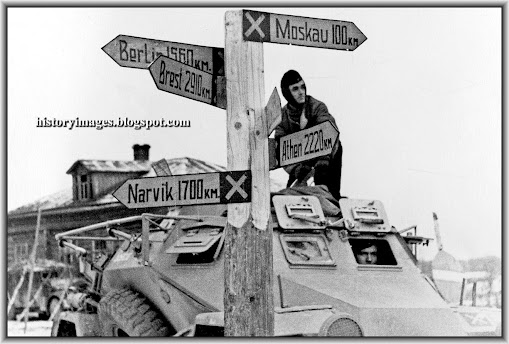
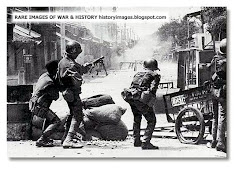
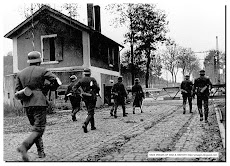
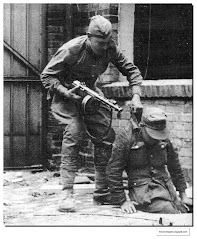
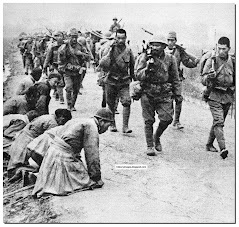
Late 1941. This German light armored car is just 100 Kms from Moscow
Battle of Moscow. 1941-42. It is significant because this was the first time the seemingly unstoppable German Army's advance was stalled. And the Russians counter-attacked ferociously. The myth that the Nazi Blitzkrieg was infallible was broken. The fortunes of Nazi Germany had begun to change. Stalingrad and Kursk followed.
But the Battle of Moscow was when the tide started to turn....
Page 59
On 18 June Timoshenko and Zhukov tried once again to persuade Stalin and the Politburo to put the army on full alert. The meeting lasted for three hours. The more Zhukov spoke, the more irritable Stalin became. He accused Zhukov of warmongering and became so abusive that Zhukov fell silent.
But Timoshenko persisted. There would be havoc, he said, if the Wehrmacht struck the troops in their present positions. Stalin was furious. ‘It’s all Timoshenko’s work,’ he told the others. ‘He’s preparing everyone for war. He ought to have been shot, but I’ve known him as a good soldier since the Civil War.’ Timoshenko reminded Stalin that he had told the cadets on 5 May that war was inevitable. Stalin replied furiously, ‘I said that so that people would raise their alertness. But you have to understand that Germany on her own will never fight Russia. You must understand this.’ He stormed out, then suddenly put his head round the door and shouted, ‘If you’re going to provoke the Germans on the frontier by moving troops there without our permission, then heads will roll, mark my words.’ In Stalin’s mouth that was not a figure of speech.

Map of German advance into Russia (Click to Enlarge)

German tank Pz.Kpfw. III ausf. H (Panzer 3) from the 7th Tank Regiment at the headquarters of the 10th Panzer Division outside Moscow. Moscow region in 1941.
VIDEO: GERMAN SOLDIERS ON THE WAY TO MOSCOW: PART 1 (GERMAN NEWSREEL)
BATTLE OF MOSCOW IN BRIEF
(historylearningsite)
VIDEO: GERMAN SOLDIERS ON THE WAY TO MOSCOW: PART 2 (GERMAN NEWSREEL)
VIDEO: GERMAN SOLDIERS ON THE WAY TO MOSCOW: PART 1 (GERMAN NEWSREEL)
BATTLE OF MOSCOW IN BRIEF
(historylearningsite)
The Battle for Moscow - the Germans code-named it 'Operation Typhoon' - started on October 2nd 1941. The capture of Moscow, Russia's capital, was seen as vital to the success of 'Operation Barbarossa'. Hitler believed that once the heart - Moscow - had been cut out of Russia, the whole nation would collapse.
The initial stages of Barbarossa have been seen as massively successful for the Germans and catastrophic for the Russians. Few would deny the success of the German attack - 28 Russian divisions were put out of action in just three weeks and more than 70 divisions lost 50% or more of their men and equipment. Blitzkrieg had ploughed through the Red Army. Hitler's belief that the Red Army would crumble seemed to be coming true. However, the Germans had also suffered in their attacks on Russia. By one month into Barbarossa, the Germans had lost over 100,000 men, 50% of their tanks and over 1,200 planes. With its army split between east and west Europe, these were heavy casualty figures. Hitler's belief that the Red Army would be crushed also meant that there had been little consideration of the Russian winter and very many of the Wehrmacht in Russia had not been equipped with proper winter clothing. The battle that raged around Smolensk had critically held up the advance of the Germans.
Ironically for an army that was to suffer from the Russian winter, 'Operation Typhoon' started off in ideal weather conditions on October 2nd, 1941. Field Marshall von Bock had been given overall command of the attack on Moscow. Hitler had ordered that units in other parts of the Russian campaign be moved to Moscow - General Hoepner's IV Panzer group had been moved from Leningrad - hence why the Germans did not have sufficient men to launch an attack on the city and why it had to be besieged. For the attack, Bock had at his disposal 1 million men, 1,700 tanks, 19,500 artillery guns and 950 combat aircraft - 50% of all the German men in Russia, 75% of all the tanks and 33% of all the planes. To defend Moscow, the Russians had under 500,000 men, less than 900 tanks and just over 300 combat planes.
Hitler had made it clear to his generals what he wanted from them. Chief-of-Staff Halder wrote in his diary:
"It is the Führer's unshakable decision to raze Moscow and Leningrad to the ground, so as to be completely relieved of the population of these cities, which we would otherwise have to feed through the winter. The task of destroying the cities is to be carried out by aircraft."
On October 12th, ten days into the attack by Bock's Army Group Centre, he received a further order from German Supreme Command:
"The Führer has reaffirmed his decision that the surrender of Moscow will not be accepted, even if it is offered by the enemy."
The order went on to instruct Bock that gaps could be left open for people in Moscow to escape into the interior of Russia where administrating them would cause chaos.
The attack started well for the Germans. The Russians found it difficult to communicate with all parts of their defences and infantry divisions frequently had to face tanks without air or artillery support. By October 7th, even Marshall Zhukov was forced to admit that all the major roads to Moscow were open to the Germans. Large parts of the Red Army had been encircled at Vyazma (the 19th, 24th, 29th, 30th, 32nd and 43rd armies) and at two places near Bryansk (the 3rd, 13th and 50th armies) such was the ferocity of the German attack and the state of the Russian army then.
Ironically, it was these armies that had been trapped near Vyazma and Bryansk that caused the Germans their first major problem in the attack on Moscow. The Germans could not simply leave nine Russian armies in their rear as they advanced east. They had to take on these trapped armies. By doing so, they slowed down their advance to Moscow to such an extent that the Red Army was given sufficient breathing space to reorganise itself and its defences under the command of Marshall Georgy Zhukov - the man who 'never lost a battle'. The choice of Zhukov was an enlightened one:
Zhukov organised his defence along the so-called 'Mozhaysk Line'. The Germans attacked this line on October 10th - by which time they had dealt with the Russians at Vyazma. Though on paper the delay to the Germans had been mere days, to the Russians it allowed them time to move their forces to where Zhukov believed they would be needed. Even so, the Germans broke through the Mozhaysk Line at a number of places and for all of Zhokov's work, Moscow was still very much threatened. Parts of the German army got to 45 miles of Moscow's centre before the tide was turned and a stalemate developed with little movement on either side.
On November 13th, senior German commanders met at Orsha. It was at this meeting that the decision was taken to start a second assault on Moscow. During the stalemate, the Russians had sent 100,000 more men to defend Moscow with an extra 300 tanks and 2,000 artillery guns.
Moscow itself had been turned into a fortress with 422 miles of anti-tank ditches being dug, 812 miles of barbed wire entanglements and some 30,000 firing points. Resistance groups had also been organised to fight both in the city, should the Germans enter Moscow and in the area around the city. In all, about 10,000 people from Moscow were involved in planned resistance activities. Lieutenant-General P A Artemyev was given the task of defending the city. Between 100 and 120 trains provided the city with what was required on a daily basis at a time when the Germans could only average 23 trains a day when they required 70 - such was the effectiveness of partisan activity.
The second assault narrowed its target area so that as much fire power could be concentrated in one area as possible. The belief that was held was that if one small part of the city was entered, all the defences surrounding it would fall once the might of the Panzer units fanned out. However, the attack met with fierce Russian resistance. The Germans got as far forward as 18 miles from Moscow's centre (the village of Krasnaya Polyana) but the Russian defence line held out. It is said that German reconnaissance units actually got into the outskirts of the city but by the end of November the whole forward momentum of the Germans had stalled. By December, the Russians had started to counter-attack the Germans. In just 20 days of the second offensive, the Germans lost 155,000 men (killed, wounded or a victim of frostbite), about 800 tanks and 300 artillery guns. Whereas the Germans had few men in reserve, the Russians had 58 infantry and cavalry divisions in reserve. STAVKA proposed to use a number of these divivions to start a counter-offensive against the Germans - Stalin himself made it clear to Zhukov that he expected a counter-attack to start on December 5th in the battle zone to the north of Moscow and on December 6th in the battle zone to the south of the city. The attacks took place at the times decreed by Stalin and they proved highly effective against an enemy that was being hit hard by sub-zero winter temperatures - night temperatures of -20F were not uncomon.
The impact of these attacks so unnerved Hitler that he issued the following order:
However, his call was in vain. The Wehrmacht was pushed back between 60 and 155 miles in places and by January 1942, the threat to Moscow had passed. Hitler's response to this was to move 800,000 men from the west of Europe to the Eastern Front - thus ending forever any chance, however very small it may have been, of 'Operation Sealion' being carried out. He also dismissed 35 senior officers as well - including the Commander-in-Chief of the Army, Brauchitsch, and the three army commanders in the field - Bock, Leeb and Rundstedt
The initial stages of Barbarossa have been seen as massively successful for the Germans and catastrophic for the Russians. Few would deny the success of the German attack - 28 Russian divisions were put out of action in just three weeks and more than 70 divisions lost 50% or more of their men and equipment. Blitzkrieg had ploughed through the Red Army. Hitler's belief that the Red Army would crumble seemed to be coming true. However, the Germans had also suffered in their attacks on Russia. By one month into Barbarossa, the Germans had lost over 100,000 men, 50% of their tanks and over 1,200 planes. With its army split between east and west Europe, these were heavy casualty figures. Hitler's belief that the Red Army would be crushed also meant that there had been little consideration of the Russian winter and very many of the Wehrmacht in Russia had not been equipped with proper winter clothing. The battle that raged around Smolensk had critically held up the advance of the Germans.
Ironically for an army that was to suffer from the Russian winter, 'Operation Typhoon' started off in ideal weather conditions on October 2nd, 1941. Field Marshall von Bock had been given overall command of the attack on Moscow. Hitler had ordered that units in other parts of the Russian campaign be moved to Moscow - General Hoepner's IV Panzer group had been moved from Leningrad - hence why the Germans did not have sufficient men to launch an attack on the city and why it had to be besieged. For the attack, Bock had at his disposal 1 million men, 1,700 tanks, 19,500 artillery guns and 950 combat aircraft - 50% of all the German men in Russia, 75% of all the tanks and 33% of all the planes. To defend Moscow, the Russians had under 500,000 men, less than 900 tanks and just over 300 combat planes.
Hitler had made it clear to his generals what he wanted from them. Chief-of-Staff Halder wrote in his diary:
"It is the Führer's unshakable decision to raze Moscow and Leningrad to the ground, so as to be completely relieved of the population of these cities, which we would otherwise have to feed through the winter. The task of destroying the cities is to be carried out by aircraft."
On October 12th, ten days into the attack by Bock's Army Group Centre, he received a further order from German Supreme Command:
"The Führer has reaffirmed his decision that the surrender of Moscow will not be accepted, even if it is offered by the enemy."
The order went on to instruct Bock that gaps could be left open for people in Moscow to escape into the interior of Russia where administrating them would cause chaos.
The attack started well for the Germans. The Russians found it difficult to communicate with all parts of their defences and infantry divisions frequently had to face tanks without air or artillery support. By October 7th, even Marshall Zhukov was forced to admit that all the major roads to Moscow were open to the Germans. Large parts of the Red Army had been encircled at Vyazma (the 19th, 24th, 29th, 30th, 32nd and 43rd armies) and at two places near Bryansk (the 3rd, 13th and 50th armies) such was the ferocity of the German attack and the state of the Russian army then.
Ironically, it was these armies that had been trapped near Vyazma and Bryansk that caused the Germans their first major problem in the attack on Moscow. The Germans could not simply leave nine Russian armies in their rear as they advanced east. They had to take on these trapped armies. By doing so, they slowed down their advance to Moscow to such an extent that the Red Army was given sufficient breathing space to reorganise itself and its defences under the command of Marshall Georgy Zhukov - the man who 'never lost a battle'. The choice of Zhukov was an enlightened one:
"In my view, Zhukov remains always a man of strong will and decisiveness, clear and gifted, exacting, persistent and purposeful. These qualities are all, undoubtedly, indispensable to a great military leader, and Zhukov has them."Marshall of the Soviet Union Rokossovsky
Zhukov organised his defence along the so-called 'Mozhaysk Line'. The Germans attacked this line on October 10th - by which time they had dealt with the Russians at Vyazma. Though on paper the delay to the Germans had been mere days, to the Russians it allowed them time to move their forces to where Zhukov believed they would be needed. Even so, the Germans broke through the Mozhaysk Line at a number of places and for all of Zhokov's work, Moscow was still very much threatened. Parts of the German army got to 45 miles of Moscow's centre before the tide was turned and a stalemate developed with little movement on either side.
On November 13th, senior German commanders met at Orsha. It was at this meeting that the decision was taken to start a second assault on Moscow. During the stalemate, the Russians had sent 100,000 more men to defend Moscow with an extra 300 tanks and 2,000 artillery guns.
Moscow itself had been turned into a fortress with 422 miles of anti-tank ditches being dug, 812 miles of barbed wire entanglements and some 30,000 firing points. Resistance groups had also been organised to fight both in the city, should the Germans enter Moscow and in the area around the city. In all, about 10,000 people from Moscow were involved in planned resistance activities. Lieutenant-General P A Artemyev was given the task of defending the city. Between 100 and 120 trains provided the city with what was required on a daily basis at a time when the Germans could only average 23 trains a day when they required 70 - such was the effectiveness of partisan activity.
The second assault narrowed its target area so that as much fire power could be concentrated in one area as possible. The belief that was held was that if one small part of the city was entered, all the defences surrounding it would fall once the might of the Panzer units fanned out. However, the attack met with fierce Russian resistance. The Germans got as far forward as 18 miles from Moscow's centre (the village of Krasnaya Polyana) but the Russian defence line held out. It is said that German reconnaissance units actually got into the outskirts of the city but by the end of November the whole forward momentum of the Germans had stalled. By December, the Russians had started to counter-attack the Germans. In just 20 days of the second offensive, the Germans lost 155,000 men (killed, wounded or a victim of frostbite), about 800 tanks and 300 artillery guns. Whereas the Germans had few men in reserve, the Russians had 58 infantry and cavalry divisions in reserve. STAVKA proposed to use a number of these divivions to start a counter-offensive against the Germans - Stalin himself made it clear to Zhukov that he expected a counter-attack to start on December 5th in the battle zone to the north of Moscow and on December 6th in the battle zone to the south of the city. The attacks took place at the times decreed by Stalin and they proved highly effective against an enemy that was being hit hard by sub-zero winter temperatures - night temperatures of -20F were not uncomon.
The impact of these attacks so unnerved Hitler that he issued the following order:
"The troops must be compelled by the personal influences of their commanders, commanding officers, and officers, to resist fanatically on their present positions, without regard to enemy breakthroughs on the flanks and in the rear. Only by leading their troops in this way can the necessary time be gained for movement of reinforcements from the homeland and the West which I have ordered to be carried out."Hitler
However, his call was in vain. The Wehrmacht was pushed back between 60 and 155 miles in places and by January 1942, the threat to Moscow had passed. Hitler's response to this was to move 800,000 men from the west of Europe to the Eastern Front - thus ending forever any chance, however very small it may have been, of 'Operation Sealion' being carried out. He also dismissed 35 senior officers as well - including the Commander-in-Chief of the Army, Brauchitsch, and the three army commanders in the field - Bock, Leeb and Rundstedt

Russian mounted patrols in 1942 February. The Russians were well-clothed in contrast to Germans who had little winter clothing
MOSCOW 1941: A CITY AND ITS PEOPLE AT WAR
By Rodric Braithwaite
EXCERPTS
Page 225
(September 1941. News reached that the Germans broken through and the road to Moscow was clear)
MOSCOW 1941: A CITY AND ITS PEOPLE AT WAR
By Rodric Braithwaite

EXCERPTS
Page 225
(September 1941. News reached that the Germans broken through and the road to Moscow was clear)
There was a bad moment when Stalin seemed to be all for shooting
Koniev for failing to stem the German advance. According to his own
account, Zhukov – himself ruthless in the application of the death
penalty – objected.
‘Shooting Koniev will not improve anything or encourage anyone.
It will only produce a bad impression in the army. Shooting Pavlov was
no use at all. Everyone knew that Pavlov should never have been put in
charge of anything larger than a division … But Koniev is not Pavlov
– he is an intelligent man. He can still be serviceable.’
‘What do you suggest?’ asked Stalin.
Zhukov recommended that
Koniev should stay on as his deputy.
Stalin asked suspiciously: ‘Why
are you defending Koniev? Is he some pal of yours?’ But he agreed to
the appointment.
A couple of days later Koniev was sent to get a grip
on the situation around Kalinin [Tver], a hundred miles Northwest of
Moscow on the Leningrad Highway, where the locals had panicked and
another gaping hole had been left in the defences. On 17 October he
was appointed to command a new Front there. He performed success-
fully for the rest of the war, and his troops were the fi rst to enter Berlin
in April 1945.

The Russians brought in fresh troops from Siberia
Page 233
Page 233
The Russians were retreating again. But now they were retreating in
good order, a few miles at a time.
The German advance slowed to a halt.
The weather was already beginning to bear heavily on the fighting. It
was not at first the snow of General Winter, but the far more intractable
mud of the rasputitsa. The fi rst snow had already fallen on 7 October
– even earlier than it had done in 1812. But it soon thawed, making
the mud still worse.
Hitler’s armies were in serious trouble long before
the snow finally settled.
The rasputitsa spared the Russians no more than it spared the
Germans. Their vehicles and their wagons sank into the mud just as
quickly. They too had to manhandle food and ammunition through the
mud when even horses failed. Their wounded faced the same nightmare
journey to the rear.
But for the time being the German offensive was
literally bogged down. At the end of October the Germans paused to
lick their wounds, sort out their lines of communication, now stretched
to breaking point, and bring up new men, new weapons, new ammunition, and new supplies for what they believed, with increasing desperation, would be the final assault on the capital of Bolshevism.

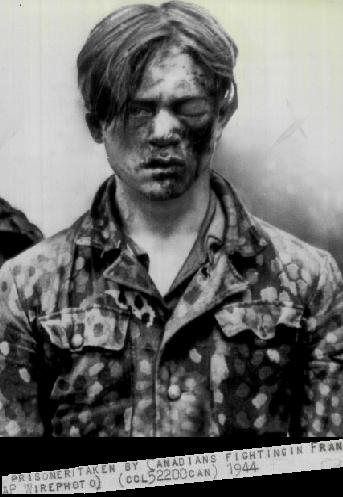
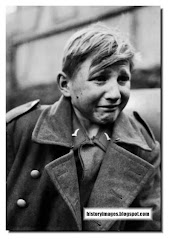
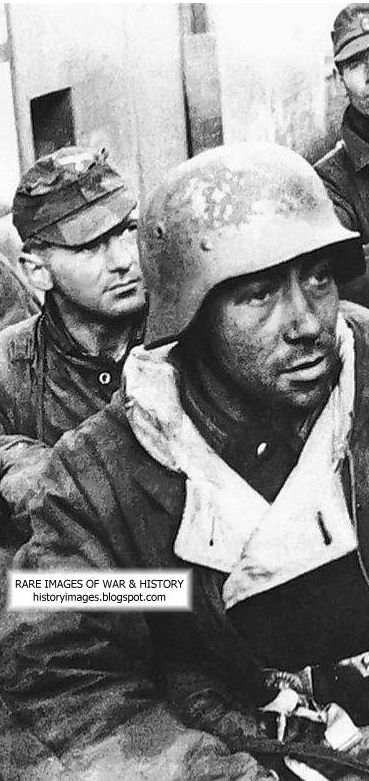
German soldiers taken prisoners near Moscow. Early 1942. One does not win wars with soldiers freezing to death. Hitler's blunder.
--------------
Page 234
--------------
As a result of the cold, the machine-guns were no longer able to fire...the result of all this was a panic...The battle worthiness of our infantry is at an end .
General Heinz Guderian - November 1941
---------------Page 234
As autumn drew in, the people of Moscow started to get very cold indeed. The mines of the Ukraine and Western Russia were
in the hands of the enemy. What little coal reached Moscow went
primarily to factories producing for the war. The electricity supply
began to break down. The Moscow City Council announced in
the press that it was halving the amount of electricity for lighting
purposes. In late November, as the Germans approached the Kashira
power station South of the city, the local authorities asked for per-
mission to blow it up. Stalin ordered instead that it be defended at
all costs and sent General Belov and his Second Cavalry Corps down
to help
Page 237
German policy in the occupied territories, at least to start with, was
contradictory, and many Russians had still not rid themselves of
their illusions of what lay in store for them if the Germans arrived.
The Germans were determined to exploit the material resources in
the occupied areas. Many did not care what the consequences might
be for the inferior races who happened to be living there.
But some
believed that it would be more profitable to get the locals to cooperate.
Russians were in any case needed for low-level administrative and guard
duties. It might even be possible to recruit an army of Russians to
fight alongside the Wehrmacht to overthrow the hated Soviet regime.
Rather like the French in Algeria and the Americans in Vietnam, the
Germans made sporadic and ultimately unsuccessful attempts to win
the hearts and minds of those they had conquered. They appealed to
three sentiments in particular: the ambition to run a private business,
the desire of the peasants for their own land, and the innate streak of
Russian anti-Semitism.
Their appeals fell on fertile ground. In many
places the ordinary German soldiers behaved well enough. They were
greeted with the traditional gifts of bread and salt in parts of Ukraine
which had suffered particularly badly from collectivisation. Such scenes
were at fi rst repeated even as they approached Moscow.
If there was ever an opportunity for the Germans to win over the disaffected, they missed it entirely. The brutal indoctrination of the German
troops, the order to shoot military commissars and Party officials, and
the operations of the SS, had already resulted in the beginnings of mass
murder. In September, in what was only the largest such massacre to
date, thirty thousand Jews – including Vasili Grossman’s mother – were
shot in Berdichev in Ukraine by the SS and their local collaborators. News of these atrocities filtered through to the population in Moscow,
and they were played up for all they were worth in the Soviet press.

Russian soldiers wait patiently for the German panzers outside Moscow with the anti-tank VA Degtyarev PTRD-41 rifle.
Page 243
 End of October 1941. Germans getting a taste of the harsh Russian climate. Part of the 2nd Panzer Group Wehrmacht crossing the water obstacle. In the foreground assault gun StuG III Ausf.C / D from the 177th battalion of assault guns (Sturmgeschütz-A BT. 177), in the background atomobil Bussing-Nag G31 with the emblem of the 2nd Panzer Group («G» - Guderian ) on the right wing.
Page 249
Dr Miller, the historian, described the scene in his diary:
 Russian soldiers with a Maxim Lebedev machine gun on the outskirts of Moscow. 1941
Page 253
 French soldiers in the Wehrmacht. Gunners from the French Legion of Volunteers against Bolshevism (Légion des Volontaires Français contre le Bolchévisme, LVF, the French division of the German Army) with a 37-mm antitank gun 3,7 cm PaK 35/36 at Moscow. In 1941.
Page 262
 German soldiers seen with a destroyed Soviet Katyusha rocket launcher. October 28, 1941
Page 277
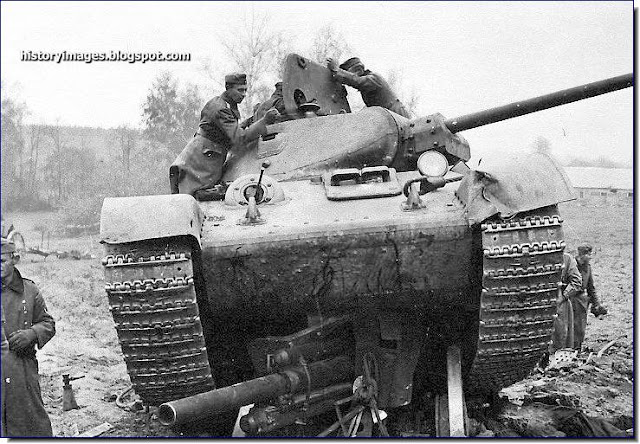 Soviet medium tank T-34-76 crushed the German field howitzer leFH.18. The Soviet tankman tried to continue moving on, but he failed and was captured by the Germans. Yukhnov District, October 1941.
STALIN GIVES A SPEECH......
Page 280
(Nov 7, 1941)
 Taking inspiration from the past. Soviet soldiers at the monument to the heroes of the War of 1812 in the village of Tarutino Kaluga region. December 1941. Here, near this village, the Russian army was encamped from September 20 to October 11, 1812 after leaving Moscow. "At this place the Russian army under the command of Kutuzov, strengthened, and saved Russia and Europe "- reads the plaque at the monument, which was opened in 1834.
Page 310
The SovInformBuro communiqué drew a conclusion which stands the test of time:
 The Soviet army counter-attacks. Late October, 1941. Tarutino-Kaluga village, Moscow region
Page 311
 The soldiers get their orders. Near Moscow. 1941. The Germans had reached the outskirts of the city
P 320
 This happened on October 17-18, 1941. A Russian rammed his armored vehicle into a Stug 3. In the image German soldiers collar the culprit
P 322
For those who had been liberated from the German occupation of the Moscow Region things were particularly miserable. ‘Ragged peasants are walking through the streets in single file, their hands in their sleeves, obviously not in their own clothes, unshaven, wild-eyed,’ Nikolai Verzhbitski noted in his diary.
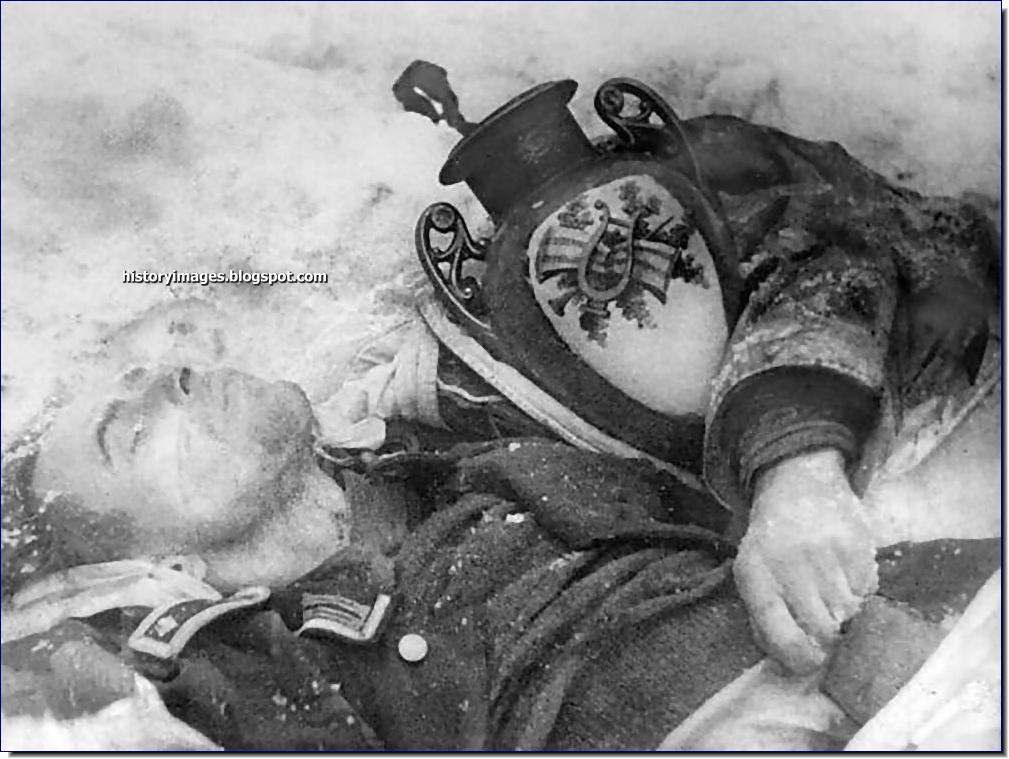
 January 1942. A German soldier clutching his loot froze in the Russian snow
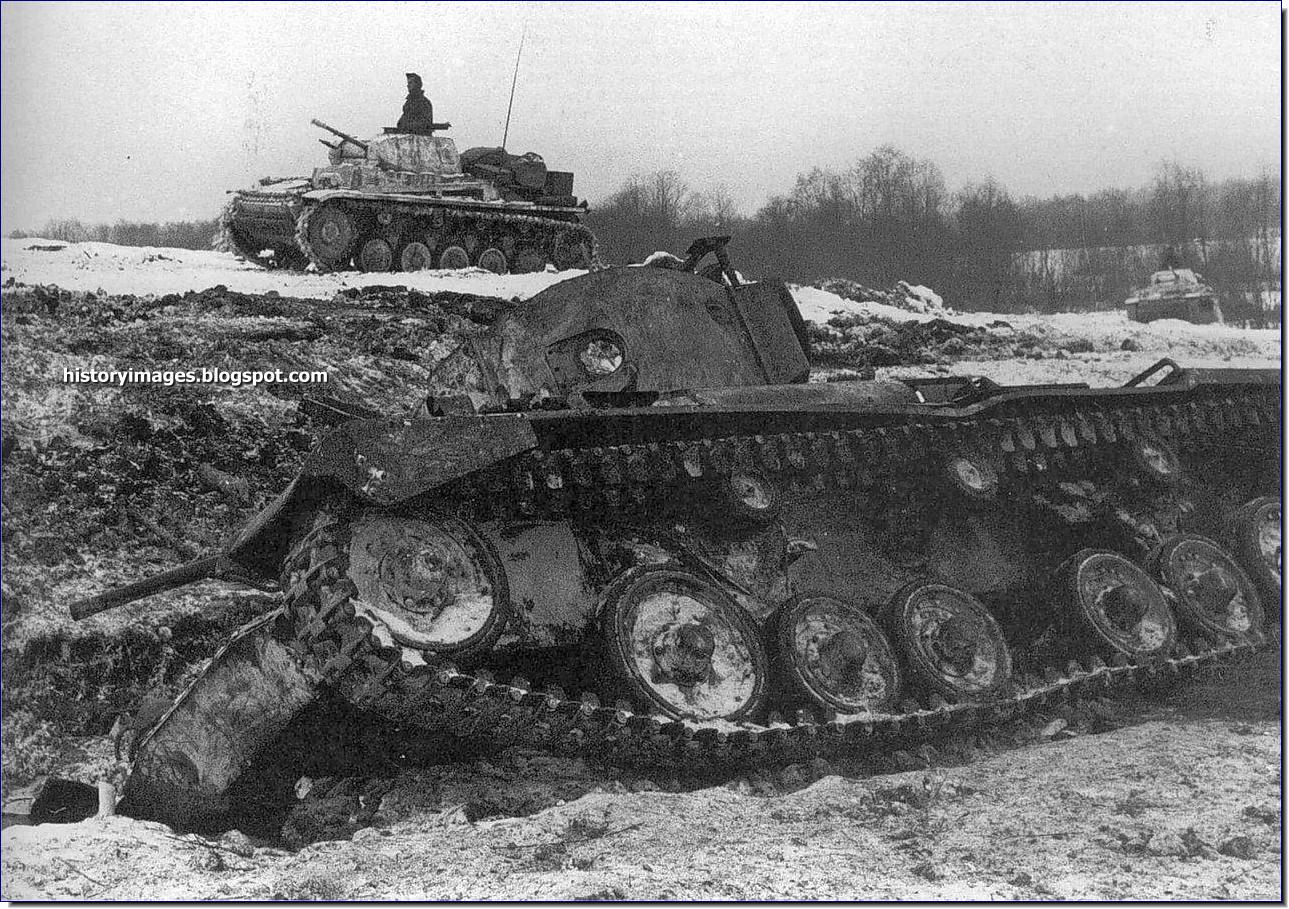
 A Panzer 2 German tank passes by a Soviet tank "Valentine» Mk.III. downed in the area of the river Istra November 1941. This is one of the first tanks, the Soviet Union obtained under Lend-Lease from the UK.
 A German Panzer 3 tank at a station near Moscow. November 1941
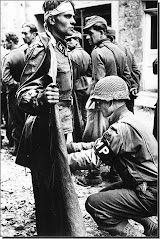
 The Red Army escorting German prisoners of war captured in the battle for Moscow. Smolensk Region. 1942
 German signalmen establishing communications with the rear. November 1941.
 German soldiers surrender. October 1941.
 German soldiers surrender. District of Tula. In 1941.
 Soviet soldiers in a trench
 Soviet troops on the march during the counter-offensive. December 1941.
 The harsh Russian winter was not the only factor that stopped the German juggernaut in 1941. Crack acclimatised Siberian troops and the T-34 tank also made a difference.
 11th Armored Division consisting of Panzer 3 tanks move in the Kaluga region
 German staff cars Kfz. 82 abandoned due to lack of fuel. December 1941
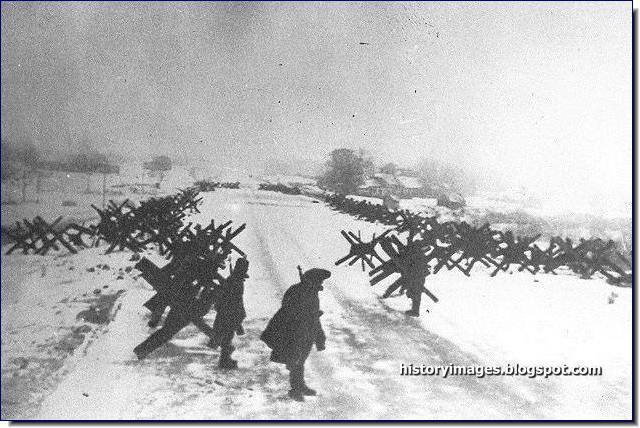
 Anti-tank fortifications on the outskirts of Moscow.
 A trophy for the Germans. A captured T-34 tank. Autumn 1941
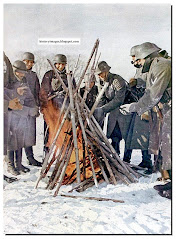
 Poorly clothed German soldiers freeze to death. December 1941
 Result of the December Soviet counter-offensive. Dead German soldiers and destroyed artillery
 Gas filled balloons. Aerial minelaying approaches to Moscow. In 1941
 Captured German motorcycles, seized by Soviet troops during the Battle of Moscow. In 1941.
 German soldiers camp during the drive to Moscow. November-December 1941
 Soviet POW captured at Vyazma. October 1941
 Russian POW at Vyazma
 The man responsible for the defense of Moscow. Zhukov (right) with N A Bulganin, a member of the military council
Books And DVDs For Battle Of Moscow
Page 243
The meeting also decided that Stalin should leave Moscow the
following day or later, depending on the situation; but within hours
he resolved to remain in the capital.
Arrangements were in any case
made for him in Kuibyshev. Nikolai Glebov, a young peasant from the
Moscow countryside, had worked on the construction of the Moscow
Metro almost from the beginning. Now he and some colleagues were
sent to Kuibyshev to begin work on a special underground bunker for
Stalin. It took them sixteen days to get there by train, and nobody told
them what they were to do until they had actually arrived. When the
job was done they went back to work in Moscow.
The bunker was never
used, and Glebov did not see it again until he went to Kuibyshev as a
tourist in the 1970s. He looked for the opening to the bunker, which
had been close to the riverside restaurant which he and his colleagues
had shared with the evacuated artists from the Bolshoi Theatre. The
entrance was now disguised as a public lavatory. Glebov poked around
and found a locked oak door. The woman attendant did not know where
it led, but she said that a couple of men came in once a month, opened
the door, went through and locked it from the other side.
Page 245
The morning of 16 October began in an ominous fashion. The night
had been quiet enough. There had been no air-raid alarms: once again
the German bombers had been grounded by low cloud and occasional
rain mixed with flakes of wet snow. At 6 o’clock precisely the loud-speakers crackled into life, as they did every day, with the morning’s
news from Levitan: ‘This is the communiqué of the SovInformBuro for
the morning of 16 October. For …’ And then his voice broke off. The
listeners heard instead what they thought at first was the well-known
Soviet patriotic song ‘The March of the Airmen’. But as they listened
more carefully, they began to realise that the familiar tune was somehow
going wrong. Some of them recognised that it was not ‘The March of
the Airmen’ at all. It was the ‘Horst Wessel Lied’, the marching song
of Hitler’s storm troopers. Were the Germans now so close that they
had been able to plug into the Moscow radio network? Then the ‘Horst
Wessel Lied’ broke off in its turn and Levitan said, as if nothing had
happened, ‘The situation around Moscow has sharply deteriorated!’ The
incident remained a mystery.

Page 249
Dr Miller, the historian, described the scene in his diary:
Everything has changed at once. (Izvestia has not come out and people
say it has been evacuated.) The SovInformBuro has got close to the
truth for the fi rst time: it says that the situation on the Western
Front has seriously deteriorated. The centre is broken through. That
is why today Moscow is like an ant heap. But the ‘ants’ seem like
strangers. People loaded down with goods are going in all directions. The dvorniks are not clearing the frozen pavements. The Metro
is closed and people are saying it is to be blown up or flooded.
People
say the Garden Ring is also to be destroyed because it is the main artery (that is what it was built for). So are any factories which have
not been evacuated or dismantled. Most of the crowd is gloomy and
silent, but some people are as light-hearted as if they were going to
the fair.
There are huge queues, because the evacuation is being used
as an excuse to distribute food products for a long time in advance.
In addition it seems as if there has been a decision to sell off the
contents of the remaining food stores (flour and sugar are being sold
at market prices. Apood of flour is being given out for each worker’s
ration card). The trams are overcrowded and there are fewer of them.
Buses too. Many of them have been taken out of service. People are
even sitting on the roofs of the trolleybuses. In the crowds, people
are saying that the Germans will arrive tonight, that Moscow, like
Paris, should be declared an open city, that the air defences have
been removed (although at 6 in the evening the guns were already
fi ring and one could see the shells exploding).

Page 253
One woman came to him in tears: ‘We thought everyone had left,
and you’d abandoned us. But it turns out you are still here!’ Shakhurin
answered loudly enough for everyone to hear: ‘If you mean the govern-
ment and the military, then no one has left. Everyone is here. Everyone
is at his post, but we are sending the factories to places where they
will be able to go on producing modern aeroplanes for our army.’ The
workers began to calm down.
Later that morning Shakhurin and other Commissars joined Stalin
in his apartment in the Kremlin. Shakhurin was one of the first to
arrive. Stalin emerged from the bedroom, greeted him, lit his pipe,
and started walking up and down. Molotov, Malenkov, Shcherbakov,
Kosygin and others came in.
Suddenly Stalin stopped and asked, ‘How
are things in Moscow?’
No one answered. They looked silently at one another, until
Shakhurin described how his workers had not been paid and had
thought themselves abandoned.
Stalin asked Molotov, ‘Where’s Zveriev?’
Molotov explained that the Commissar for Finance was in Gorki
on the Volga.
‘Fly the money in immediately,’ said Stalin.
Shakhurin reported that the trams and the Metro were not working.
The bread shops and other shops were closed. There was talk of looting
in the city.
Stalin thought for a bit, and said, ‘Well, that’s not so bad. I thought things would have been worse.’ Then he turned to Shcherbakov and added, ‘We need to sort out the trams and the Metro immediately. Open the bread shops, the stores, the canteens and get the clinics going with whatever doctors are still in the city. You and Pronin must speak on the radio today, appeal for calm, and tell people that you will make sure that all the public services work normally.’
Pronin issued the necessary orders that evening.
Stalin thought for a bit, and said, ‘Well, that’s not so bad. I thought things would have been worse.’ Then he turned to Shcherbakov and added, ‘We need to sort out the trams and the Metro immediately. Open the bread shops, the stores, the canteens and get the clinics going with whatever doctors are still in the city. You and Pronin must speak on the radio today, appeal for calm, and tell people that you will make sure that all the public services work normally.’
Pronin issued the necessary orders that evening.

Page 262
The evacuation accelerated rapidly once the German assault on
Moscow began. On 7 October Pronin ordered the urgent evacuation
of women who were not in employment, together with their children.
The Moscow militia was responsible for enforcing the order. Those
who refused to go were to be prosecuted.
On 11 October plans were
made to evacuate 300,000 more women and children from the Moscow
Region. On 13 October Moscow’s scientific institutes were ordered to
leave the city within two days: twenty-four wagons were made available for the scientists and their families, and another thirty-nine for their
equipment.
Most people were evacuated from Moscow by train. By now there
were no longer any orderly timetables. The few passenger trains still
coming from the East quickly disgorged their passengers and left just
as quickly to avoid the German bombers. Whole trains disappeared
to distant parts of the country and were lost. The system was on the
verge of collapse.

Page 277
Moscow itself was becoming a fortress. By November the three
new defensive lines were taking shape: along the Outer Railway Ring,
and along the lines of the ancient concentric fortifications of Moscow,
the Garden Ring and the Boulevard Ring in the very centre of the city . Yevgeni Anufriev, Vladimir Frolov, Yevgeni Teleguev,
their comrades from the OMSBON and the Dzerzhinski Division, and
tens of thousands of other soldiers and civilians had barricaded the
roads into the city with sandbags which looked like bags of flour under
their covering of light snow.
There were firing slits in the barricades,
protected by armoured shields, and no more than a narrow gap to allow
vehicles through. The buildings at each street corner were turned into
fortifi ed machine-gun nests. Machine guns and anti-tank detachments
were positioned behind bricked-up windows and on balconies.
Although the city transport was working again, many of the vehicles
had been commandeered for military purposes. The buses on line No.
21 were taking reinforcements out along the Volokolamsk Highway
as far as Krasnogorsk, only ten miles from the front itself. Other buses
were being used as ambulances. Trams travelled, nose to tail, carrying
volunteers, with guns, boxes of ammunition and fi eld kitchens on their
platforms. The back of each tram carried a white stripe, so that the
driver of the following tram could see it in the dark; but the blackout
was broken anyway by the flashes from the overhead lines.
German prisoners taken during October cheekily told their captors that
the victorious Wehrmacht would parade on Red Square on 7 November
– the Anniversary of the Revolution. Hitler had said so.

STALIN GIVES A SPEECH......
Page 280
(Nov 7, 1941)
At 7 o’clock a special train drew up on the other platform. The doors
opened very quietly. The first person to step out was Stalin, followed
by members of the Politburo, the Government, and the Moscow city
authorities. The applause went on for nearly ten minutes. Kolosova
thought Stalin looked thinner and greyer than when she had last seen
him at the May Day Parade: the strain of the war was beginning to
tell.
The audience in the station sat in complete silence as Stalin spoke
simply, deliberately, and with his habitual Georgian accent. Because
of the poor acoustics, it was not always possible to distinguish individual words, which were in any case from time to time drowned out by
applause.
VIDEO: STALIN SPEAKS ON NOVEMBER 7, 1941
He spoke with his usual relentless logic – crude, forceful, and
difficult to resist. He began by claiming that in four months of war the
Germans had lost four and a half million people, against Soviet losses
of 350,000 dead, 378,000 missing and just over one million wounded.
These figures were of course wildly misleading, and even among his
listeners there were sceptics who found them hard to believe.
But
he went on to analyse – objectively enough – why the German blitzkrieg was doomed to eventual defeat in Russia. In 1940 the French
had been robbed of their will to fight by the internal disintegration of
their system. The Germans believed that similar forces of disintegration would operate in the Soviet Union. They assumed that the initial
defeats of the Red Army would lead to a collapse in Soviet morale and to
discord between the peoples of the Soviet Union. It was quite possible,
said Stalin, that any other state which had lost so much territory would
have collapsed. The fact that the Soviet Union had held together was a
tribute to the regime.
The Germans, Stalin went on, had grossly overestimated their own
strength and underestimated that of the Red Army. The Red Army
lacked the experience of the battle-hardened Wehrmacht. The Germans
had had the advantage of surprise and an overwhelming superiority in
modern tanks and aircraft. But as they advanced further into the depths
of Russia their lines of communication were becoming ever longer and
increasingly vulnerable to attack by Soviet partisans.
Moreover the Soviet Union, Stalin emphasised, was not alone.
The Germans had never thought that the Western democracies and
the Soviet Union would be able to combine against them. But unlike
Germany, Britain and the United States were democratic countries even
though they were capitalist. The coalition between the Soviet Union
and the Western democracies was a growing reality. The British and
Americans were not doing any actual fighting in the West. But they
were already supplying the Soviet Union with tanks and aeroplanes,
aluminium, lead, nickel, and rubber.
The Nazi defeat was inevitable
because between them the three could outproduce Germany. Above all
the Soviet Union and its allies enjoyed the moral advantage of fighting
a war of defence, a war of liberation against an imperial power which
had brought most of mainland Europe under its yoke.

Page 310
The SovInformBuro communiqué drew a conclusion which stands the test of time:
The Germans complain that it was the winter that prevented them
from carrying out their plan to capture Moscow. But first of all,
the real winter has not yet started around Moscow: the frosts are
no more than 3–5 degrees. Secondly, complaints about the winter
demonstrate that the Germans did not bother to equip their army
with warm clothing, although they proclaimed to the whole world
that they had long been prepared for a winter campaign. And the
reason why they had not equipped their army with winter clothing
was because they hoped to finish the war before winter began. That
was a most serious and dangerous miscalculation … It is not the
winter that was to blame, but an organic defect in the way the
German High Command planned for the war.

Page 311
As the Germans approached Moscow, Stalin ordered the systematic destruction of villages in the occupied territories to deny them
shelter. Zhukov ordered the inhabitants to be driven out of a zone
three, later fifteen, miles wide behind the front line. These orders were
rigidly enforced. On 25 November the 5th Army reported that they
had partially or wholly destroyed fi fty-three villages by fire or artillery
bombardment. The commissar of the 53rd Cavalry Division apologised
to his superior at the headquarters of the 16th Army for the ‘unnecessary and damaging liberalism’ with which his men had hitherto carried out their orders, and promised to do better in future.
THE LEGEND OF ZOYA KOMSOSEMYANSKAYA
Among the fi rst students in Kuntsevo was Zoya Kosmodemyanskaya, an eighteen-year-old in her last year at school. After five days’
training in demolition, small arms and unarmed combat, she was
assigned to Partisan-Reconnaissance Unit No. 9903. At the beginning
of November she crossed the front on her first mission in a group of
twelve, carrying incendiary material, a gun, rations and the regulation allocation of one hundred grams of vodka a day. The group was
ambushed by a German patrol. Some of its members were killed. Others
fled. Others, including Zoya, carried out their mission and returned
safely to their base.
On 21 November several groups of Unit No. 9903 went back across
the line with orders to burn down ten villages. Zoya’s group consisted
of herself, Boris Krainov and Vasili Klubkov. Their target was the
village of Petrishchevo, about fi fty miles away towards Mozhaisk. Zoya
was to burn buildings at the Southern end of the village, Klubkov at
the Northern end and Krainov in the centre.
The details of what happened are still unclear. Krainov successfully
set his targets on fire and got away to the agreed rendezvous. Zoya set
fire to her targets, which included three houses and a stable: twenty
horses and a deal of equipment were destroyed. But as she was making for the forest she was picked up by a German patrol.
Klubkov failed to
set fire to anything. He too was caught. It was now 28 November.
Zoya was questioned in one of the surviving izbas. She denied that
she had been involved in the arson attack. She was then confronted
with Klubkov, who had admitted that he was a member of the group
of saboteurs and had named both Zoya and Krainov. Zoya was stripped
and beaten so brutally that two German soldiers left the room in
disgust.
Despite Klubkov’s evidence Zoya refused to give her real name,
or any details of her mission or her previous training. Later that night
Solina and Smirnova, two of the village women whose houses had been
burned, came to abuse her. One of them threw a bowl of washing-up
water over her.
The next morning she was taken to the centre of the village, where
a gallows had been erected at the crossroads. The Germans hung round
her neck a placard with the word ‘Arsonist’ in Russian and German.
About a hundred German soldiers came to watch and photograph the
scene. The villagers were ordered to attend, though some managed to
slip away. Eyewitnesses later said that before she died, Zoya told the
German watchers that they would do better to surrender while they
still had the chance: ‘You can’t hang us all!’ Her body was left on the
gallows for six weeks, until it was buried on the orders of the retreating
Germans just before the village was liberated on 12 January.

P 320
The first stage of the Russian counterattack was almost totally success ful. In the twenty days after resuming their offensive against Moscow
in the middle of November, the Germans had advanced up to seventy
miles to the very outskirts of the city. Now, in thirty-four days, along
six hundred miles of front, the Russians advanced in some places more
than 150 miles. The Germans had lost the strategic initiative for the
first time since 1939. The immediate threat to the capital had been
averted. It was never to be renewed, despite a nervous moment in April
1942, when the barricades were briefl y re-erected as the Germans began
once again to bestir themselves for their summer offensive.

P 322
For those who had been liberated from the German occupation of the Moscow Region things were particularly miserable. ‘Ragged peasants are walking through the streets in single file, their hands in their sleeves, obviously not in their own clothes, unshaven, wild-eyed,’ Nikolai Verzhbitski noted in his diary.
I ask them: Who are you? – Prisoners, they answer (that’s what peasants who have been under the Germans call themselves) […] I spoke to a woman ‘prisoner’ (she was from a collective farm from the village of Krasnoe near Tarutino in the Maloyaroslavets Region). The Germans had been in their village. ‘They slaughtered all the cattle and chickens. They ate every two hours. They didn’t let us into our cottages. We had to sleep in the open and cook on bonfi res. They did allow some of the mothers with small children to sleep under the beds or in the porches. They did their own cooking on our Russian stoves, but they didn’t know how to […] We were afraid they would burn our houses. They demanded to see the chairman of the collective farm. It was a woman, eight months pregnant. We brought her in, the officer saw her belly, roared with laughter, and sent her away in peace. They didn’t touch anyone, they didn’t dig up the ground to see if we had hidden our goods. Two days before they retreated, they told us to go into the woods, and allowed us to take our cows with us. They burned the village as they left. They left two houses at the request of the women, so that there would be somewhere to shelter the children. But three versts away the Germans were hanging and beating people […] They hanged the woman teacher and the chairman of the collective farm and they raped the girls.
As the Russian soldiers pushed forward, they came across enough
evidence of what the Germans had done to convince even the most
sceptical of the nature of the enemy they were fighting. In Volokolamsk
they found a scaffold on which hung the corpses of eight of the local
people. The Russian commander refused to allow the victims to be cut
down for several days, to allow his men to see what the Germans were
capable of.




Books And DVDs For Battle Of Moscow